
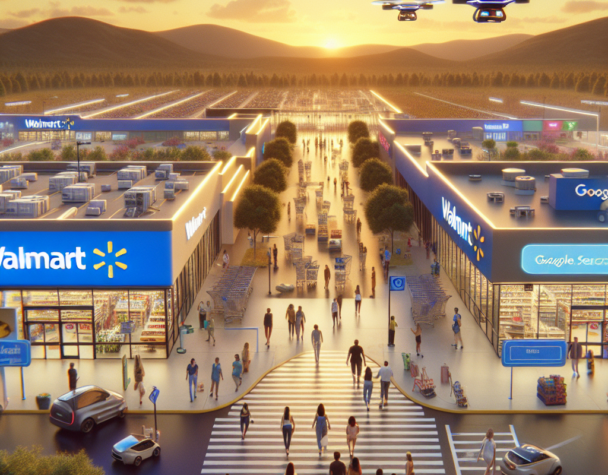
Walmart Surges: AI Deal, Drones, Checkout Reboot
Wed, January 14, 2026Introduction
This past week brought a string of tangible operational developments for Walmart that moved the needle on WMT stock. Investors reacted to a combination of technology partnerships, fulfillment expansions, and in-store operational changes that together underscore Walmart’s dual strategy: push hard on digital capabilities while pragmatically fixing execution problems in physical stores. The most consequential items were the Google Gemini AI integration, an expanded drone-delivery plan, and a partial rollback of self-checkout kiosks—each with immediate implications for revenue channels, cost structure, and investor confidence.
WMT Stock Reaction and Context
On January 12, 2026, Walmart shares closed at an all-time high near $117.48 as institutional buyers rotated toward defensive, cash-generative companies. Market participants cited Walmart’s strengthened tech partnerships and accelerated fulfillment initiatives as reasons for the buying. These concrete operational moves provided a clearer growth narrative than speculative promises, prompting renewed interest from value- and income-focused investors.
Why operational news matters to investors
Operational changes translate to predictable impacts on same-store sales, online penetration, fulfillment costs, and advertising revenue. Unlike vague strategic plans, announcements that expand delivery capacity or change store staffing provide measurable levers investors can model into near-term cash flow and margin forecasts—hence the notable reaction in WMT stock.
Google Gemini Partnership: Search Meets Commerce
Walmart’s announcement of a conversational shopping integration with Google’s Gemini AI positions its product catalogue directly inside a rapidly adopted search paradigm. Early price-action showed a more than 3% share uptick around the disclosure, reflecting investors’ view that increased visibility in AI-driven search can lift online conversion rates.
Potential upside areas
- Higher product discovery: Conversational search can expose more SKUs—especially private-label and high-margin items—to buyers who wouldn’t reach them through traditional search paths.
- Ad and referral revenue: Greater traffic from AI queries can grow Walmart Connect advertising dollars if search-driven placements are monetized.
- Reduced friction: Voice and chat-driven ordering shorten the path to purchase, potentially boosting repeat usage among time-sensitive consumers.
Drone Delivery Expansion: Faster Last-Mile Fulfillment
Walmart publicly committed to substantially expanding drone deliveries, targeting more than 150 stores offering service in 2026 and broader coverage in 2027. Several metropolitan rollouts—including Houston—were scheduled this month, signaling an operational acceleration that tightens competition with other fast-delivery players.
Economic and competitive implications
Drone delivery shifts the last-mile cost curve for very small, high-density orders. If successful, it can increase customer satisfaction for convenience-driven purchases while lowering per-delivery variable costs versus traditional courier models for qualifying shipments. For investors, faster delivery capability supports higher online frequency and can bolster loyalty metrics—both positive inputs for forecasting long-term digital revenue growth.
Self-Checkout Rollback: Execution Over Experimentation
Concurrently, Walmart began reversing parts of its broad self-checkout rollout in select states, reintroducing staffed lanes where kiosks produced long waits, theft issues, or customer frustration. This move highlights a pragmatic operational discipline: deploy technology, measure customer outcomes, and reverse course when execution degrades the shopping experience.
What this tells investors
- Focus on experience: Walmart is willing to sacrifice short-term automation targets to preserve throughput and customer satisfaction.
- Loss-prevention and labor mix: Re-staffing lanes may raise near-term personnel costs but could reduce shrink and improve transaction speeds—improving net profitability over time.
- Balanced innovation approach: The coexistence of aggressive drone expansion and selective rollback of in-store tech shows management is calibrating investments by outcome rather than by ideology.
Conclusion
This week’s concrete operational announcements provided a clearer growth and execution story for Walmart. The Google Gemini tie-up amplifies digital discovery and monetization potential; the drone expansion accelerates last-mile capabilities that can drive online frequency; and the targeted self-checkout reversals demonstrate a management team that prioritizes customer experience and loss prevention. For WMT shareholders, these events offer measurable pathways to revenue and margin improvements, and they explain the recent uptick in institutional demand for the Dow component.
Investors evaluating Walmart should incorporate the impact of AI-driven search traffic, incremental delivery capacity from drones, and any near-term labor or shrink costs tied to checkout strategy changes when modeling the company’s near- and medium-term performance.