
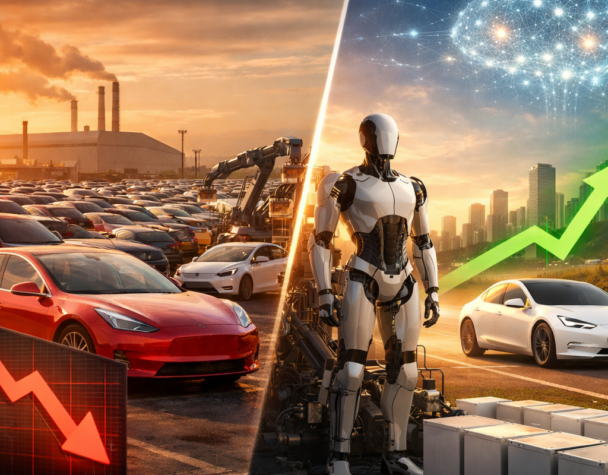
TSLA Slide, Bounce: Q1 Deliveries and AI Bets Rise
Mon, April 20, 2026Introduction
Tesla (TSLA) experienced a volatile week as concrete operational data collided with longer-term strategic narratives. A clear delivery miss and an associated inventory build triggered a sell-off, while discrete wins—regulatory approvals for FSD in Europe, a UBS upgrade and encouraging AI/robotics metrics—prompted a sharp rebound ahead of the company’s earnings report. For investors focused on automotive and clean-energy equities, the events of the past week sharpen the distinction between cyclical execution risks and structural growth catalysts.
Delivery Shortfall and Inventory: The Immediate Driver
Tesla reported first-quarter deliveries of 358,023 vehicles, a sequential decline versus Q4 and slightly below consensus. Production exceeded deliveries at roughly 408,000 units, leaving an inventory overhang of about 50,000 vehicles. At the same time, energy-storage deployments declined materially—about a 38% quarter‑over‑quarter drop to 8.8 GWh.
Why the numbers mattered
The delivery shortfall is a tangible, near-term metric institutional investors watch closely. Higher production with lower deliveries creates working-capital pressure, potential price or incentive actions to clear stock, and investor scrutiny over demand trends. The energy-storage slowdown is especially notable because energy products have been a key margin diversification play for Tesla; a sharp quarter-over-quarter decline amplifies concerns about revenue mix and near-term cash flow.
Sentiment Shift: After-Hours Bounce and Analyst Reassessments
Following the delivery report and a period of weakness, TSLA staged a significant after-hours bounce—an example of how technical dynamics and short-covering can accelerate price recovery even without new positive fundamentals. Over the last week, sentiment flipped further when UBS upgraded Tesla from Sell to Neutral, arguing that recent weakness had been substantially priced in and reaffirming the long-term case tied to AI and autonomy.
What drove the rebound
The rebound was driven by a mix of factors:
- Analyst repositioning—UBS’s upgrade signaled to some investors that downside risk near term was limited.
- Regulatory and product progress—approval of supervised Full-Self-Driving (FSD) in the Netherlands and a Spring software update (including a Grok AI voice assistant) reinforced Tesla’s software and AI narrative.
- Technical buying—high-volume after-hours trading and short-covering amplified moves once buyers stepped in.
Operational AI and Robotics: Reinforcing the Long-Term Thesis
While delivery and storage numbers reveal short-term friction, operational data from Tesla’s AI and robotics efforts continued to show measurable gains. Internal deployments of Optimus robots in factories were reported to yield production-efficiency improvements in the mid-teens. Separately, improvements to FSD (notably Version 14) have led to large percentage gains in miles per intervention year-over-year—figures quoted by analysts point to several-hundred-percent improvements in safety metrics.
Why these developments matter for valuation
These advances support a dual-revenue thesis: software and services (FSD subscriptions, AI-driven features) and robotics-enabled manufacturing uplift. For investors, that means Tesla’s valuation cannot be viewed as solely dependent on car sales; the company is increasingly judged on its ability to monetize software, scale AI infrastructure, and extract value from robotics investments. However, translating operational improvements into predictable revenue streams remains a longer-term execution challenge.
What Investors Should Watch Next
Key near-term items include Tesla’s earnings release and related commentary on demand, inventory management, energy deployments, and capital spending for AI infrastructure. Investors will also scrutinize guidance for FSD rollouts, the scale-up timeline for Optimus deployments, and any regional demand signals that clarify whether the delivery shortfall was an isolated timing issue or an early sign of weakening end-market demand.
Conclusion
The week highlighted a bifurcated risk profile for Tesla: concrete operational pressures that can compress near-term earnings and cash flow, paired with substantive progress on AI, autonomy, and robotics that underpin a higher long-term multiple if monetization follows. For disciplined investors, the immediate task is to separate transient, execution-driven volatility from durable, strategic gains—and to price TSLA accordingly ahead of upcoming corporate disclosures.