
Teradyne: AI Demand Fuels Test & Robotics Growth
Tue, April 21, 2026Introduction
Teradyne (NASDAQ: TER) has emerged over the past week as a focal point for investors tracking the intersection of AI-driven semiconductor testing and industrial robotics. A string of disclosures — including the company’s annual report, recent quarterly results, conference commentary, and new manufacturing investments — provide concrete, company-level developments that directly influence TER’s revenue outlook and cost profile.
Recent company developments and why they matter
1. Financial results and AI-driven demand
Teradyne reported a strong finish to 2025 with Q4 revenue of about $1.1 billion, up roughly 44% year-over-year, and full-year revenue of $3.2 billion (a ~13% increase). Semiconductor test revenue was the core driver, contributing roughly $883 million in Q4. Management attributed a rising share of revenue to AI-related demand — more than 60% in Q4 and management expects that contribution to top 70% of Q1 revenue — demonstrating a pronounced shift toward AI compute as the primary revenue engine.
2. Upbeat guidance vs. street expectations
Teradyne issued Q1 guidance in the range of $1.15–$1.25 billion, a material beat versus prior consensus near $942 million. The stronger guidance reflects continued demand strength in semiconductor test, particularly for AI-centric chips such as merchant GPUs and other high-density compute devices.
3. Strategic targets and product positioning
At a recent industry conference, Teradyne outlined tactical goals tied to AI compute: pursuing roughly a 30% share in merchant GPU testing and highlighting dominant positions in wafer-stack testing (excl. one major memory customer) where market share exceeds 50%. The UltraFLEXplus platform was singled out as a central capability for testing AI accelerators and networking chips used in data centers.
4. Cost actions and reported severance
The company disclosed restructuring and severance charges totaling about $29.4 million in 2025, with roughly $24.3 million tied to its Semiconductor Test division and remaining charges linked to Robotics. Management expects these charges to be fully recognized by the end of Q3 2026, indicating an active effort to streamline operations and improve operating leverage.
5. Robotics expansion: U.S. hub and “Physical AI” narrative
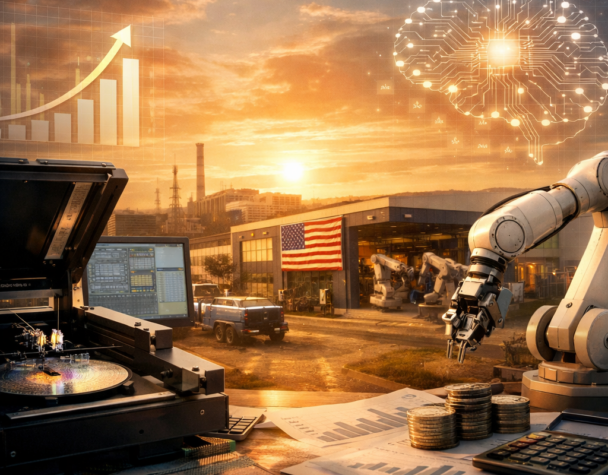
Teradyne is expanding its robotics footprint with a new robotics operations hub in Wixom, Michigan, intended to produce Universal Robots cobots and MiR autonomous mobile robots, provide training and service, and create over 200 jobs. The company is advancing the “Physical AI” thesis — embedding AI into robotic systems to deliver more adaptable automation — which management argues can drive more software-like, higher-margin revenue and reduce cyclical swings tied strictly to semiconductor hardware demand.
Investor implications
- Near-term revenue upside: Elevated AI-related test demand and materially stronger guidance create tangible upside to near-term top-line expectations for TER.
- Margin dynamics: While semiconductor test is high-margin, the robotics segment offers an opportunity to smooth earnings volatility if software and service attach rates rise as management expects.
- One-time restructuring: The reported $29.4 million in charges is a short-term headwind but should improve reported margins once fully realized.
- Execution risk: Meeting share targets in merchant GPU testing and scaling new robotics manufacturing in the U.S. are execution-dependent and will determine the durability of recent upside.
Conclusion
Recent, verifiable company actions — stronger-than-expected guidance, documented AI-driven revenue concentration, platform positioning with UltraFLEXplus, and a concrete investment in U.S. robotics manufacturing — shift Teradyne’s near-term narrative from uncertain cyclical recovery to tangible AI-led acceleration plus strategic diversification. The reported restructuring charges are notable but finite; if Teradyne executes on GPU testing share gains and converts robotics growth into higher-margin recurring revenue, the company’s revenue mix and margin profile could materially improve over the next several quarters.
This synthesis focuses on concrete disclosures and measurable developments that directly affect TER’s financial trajectory and operational footprint.