
Seagate (STX) Slides After TurboQuant Memory Shock
Tue, April 14, 2026Seagate (STX) Slides After TurboQuant Memory Shock
Last week brought a concentrated set of developments that directly affected Seagate Technology (ticker: STX). An industry announcement about TurboQuant, a new memory‑compression technique, triggered a swift re‑pricing of storage and memory names. At the same time, procurement pauses among major cloud providers and capacity adjustments across supply chains created a mixed signal: potential demand risk versus tight supply that could support prices. This article breaks down those concrete events, quantifies their near‑term impact on STX, and outlines the practical implications for investors.
What Happened: Key Events That Moved STX
TurboQuant memory‑compression announcement
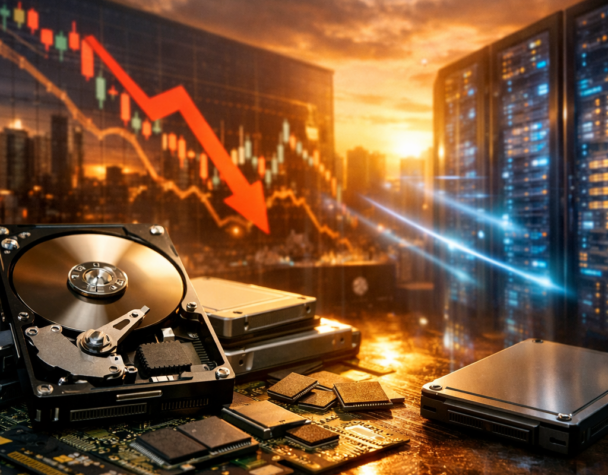
Alphabet’s unveiling of TurboQuant — a high‑efficiency memory‑compression algorithm reported to reduce memory needs materially — sparked an immediate market reaction. Investors treated the innovation as a potential long‑term headwind for raw storage demand, pushing Seagate shares down by roughly 9% in the immediate aftermath. The sell‑off wasn’t isolated: other semiconductor and storage stocks also declined (Micron and Western Digital experienced double‑digit drops), reflecting the market’s sensitivity to technologies that could lower hardware requirements for AI workloads.
Hyperscaler procurement pauses and supply adjustments
Concurrently, reports surfaced that some large cloud operators temporarily paused storage procurement while reassessing capacity plans. On the supply side, manufacturers — including Seagate — have taken steps such as permanent factory closures and inventory drawdowns. These actions have lengthened lead times for high‑capacity drives and reduced excess inventory, producing a tighter supply environment even as demand signals fluctuate.
Why These Events Matter for Seagate
Short‑term volatility vs. medium‑term pricing power
TurboQuant introduced short‑term uncertainty: if memory‑efficiency gains meaningfully reduce the physical storage footprint required by AI, demand growth could slow relative to prior expectations. That concern explains the rapid drop in STX. However, supply tightening — from factory closures and depleted buffers — works in the opposite direction, supporting pricing and margins. Think of it as two forces on a scale: innovation that could reduce unit demand on one side, and constrained physical supply that sustains prices on the other.
Earnings and demand signals from AI customers
Despite the headline volatility, Seagate’s recent earnings beat reinforced that hyperscale and AI customers still represent a strong revenue stream today. Over the past week Seagate posted results that outperformed expectations, and the stock also showed resilience with a weekly uptick following the initial shock. These results indicate that, for now, hyperscalers continue to expand capacity — albeit with more careful procurement timing.
Practical Implications for Investors
Investors should differentiate between two time horizons:
- Near term: Expect elevated price swings. Market reactions to announcements like TurboQuant can be swift and severe, even if their commercial impact is gradual. Watch hyperscaler procurement updates and quarterly order trends closely.
- Medium term: Focus on the balance of supply constraints and secular AI/data center growth. If supply remains tight, Seagate may retain pricing power even with modest reductions in unit demand.
Analogously, consider TurboQuant as a fuel‑efficiency advance in automobiles: better efficiency can reduce fuel demand per mile, but if carmakers cut production and parts become scarce, gasoline prices may remain higher than expected. For Seagate, improvements in memory efficiency could lower storage needs per AI model, but constrained drive supply and ongoing data growth can offset that effect.
Conclusion
The past week’s developments produced clear, tangible drivers for STX: a technology announcement (TurboQuant) that raised legitimate questions about future hardware consumption, and supply/procurement dynamics that preserved pricing leverage for incumbents like Seagate. For investors, this creates a nuanced tradeoff between short‑term volatility driven by headline technology news and underlying structural demand plus supply discipline that supports margins. Monitoring hyperscaler procurement behavior and concrete adoption metrics for memory‑compression technologies will be essential to refine the investment view.
Data points referenced: approximate 9% decline in Seagate shares on the TurboQuant reaction; reported double‑digit drops in competitors; recent earnings beat and resilient demand from AI data centers.