
STLD Q1 Outlook Up; Scrap Pressure Narrows Margins
Tue, March 24, 2026STLD Q1 Outlook Up; Scrap Pressure Narrows Margins
Steel Dynamics (STLD) handed investors a mixed but concrete set of updates in the last week: a materially stronger Q1 earnings outlook and a modest dividend raise were balanced against the headwind of surging scrap costs. For shareholders and active investors tracking EAF-based producers, the combination of robust downstream demand and rising input costs creates a clear set of short- to medium-term trade-offs to evaluate.
Quarterly Guidance, Backlog Growth, and Capital Return
Upgraded Q1 EPS Guidance
STLD’s recent guidance for Q1 shows a substantial year-over-year improvement in expected earnings per share, with the company projecting roughly $2.73–$2.77 versus about $1.44 for the same quarter a year earlier. This signals stronger near-term operating performance driven by downstream demand, particularly from fabrication orders tied to data-center construction and infrastructure projects. The guidance beat expectations on transparency and demonstrates management’s confidence in order flow.
Fabrication Backlog and Dividend Increase
Management disclosed a notable rise in the fabrication backlog—reported in recent investor commentary as roughly a one-third increase versus the prior period. That backlog expansion aligns with higher demand for downstream, value-added steel products, often more profitable than commodity coil. STLD also raised its quarterly dividend by 6% to $0.53 per share, a cash-return move that underscores durable cash generation despite raw-material pressure.
Scrap Price Spike: Immediate Margin Implications
Magnitude and Drivers of Scrap Inflation
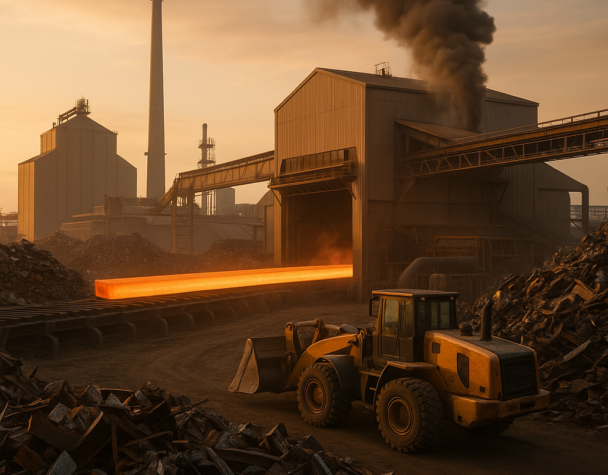
U.S. shredded ferrous scrap prices climbed materially in recent months, with east-of-Mississippi quotes reported near $420 per gross ton—up from about $389 year-over-year and roughly $370 three months prior. The spike reflects tighter scrap availability amid higher EAF utilization and weather-related logistics disruptions. For STLD, which relies on electric-arc furnaces and recycled ferrous feedstock, the move higher in scrap costs is a direct input-cost pressure.
How Scrap Moves Affect EAF Producers
Elevated scrap is a two-sided factor: it boosts revenue for recycling players but squeezes margins for integrated EAF mills unless steel selling prices widen enough to preserve spreads. STLD’s pricing power in value-added fabrication and its ability to pass through costs in commodity steel segments will determine near-term margin performance. Think of it as a leaky pipeline: stronger downstream sales increase volume through the plant, but widened input costs reduce the net flow of profit unless pricing or operational efficiencies compensate.
Downstream & Distribution Shifts: Service-Center Deals Matter
Consolidation Among Service Centers
Recent consolidation activity among North American service centers is altering distribution channels. Large transactions—such as an all-stock consolidation between major service-center operators targeting sizable synergy captures—reshape bargaining dynamics and logistics footprints. For a steelmaker with an integrated downstream presence like STLD, those moves can affect demand patterns, lead times, and the economics of direct vs. third-party distribution.
Competitive and Strategic Implications
Consolidation can produce both headwinds and tailwinds. On one hand, larger service-center customers may command tougher pricing and longer payment terms. On the other, streamlined distribution networks and rationalized capacity can stabilize margins industry-wide. STLD’s expanded fabrication backlog gives it leverage in negotiations for higher-margin, specialized work—an advantage if it can maintain throughput while managing scrap cost volatility.
Investor Takeaways and Risk Considerations
Three practical considerations emerge from the recent news:
- Near-term fundamentals are stronger: Q1 guidance and backlog growth point to improved demand for STLD’s downstream products.
- Input-cost sensitivity is rising: Scrap-price inflation is a tangible margin risk for EAF producers; monitoring steel spreads and STLD’s pricing moves will be essential.
- Strategic positioning matters: Service-center consolidation could reshape downstream economics; STLD’s fabrication scale and product mix may insulate it relative to commodity-only peers.
As investors weigh STLD, treat the present environment as a combination of earnings momentum and cost uncertainty. The dividend move and backlog are positive signals about cash flow and demand, but elevated scrap means margin volatility until spreads normalize or pricing adjusts.
Conclusion
Last week’s developments present a clear narrative: Steel Dynamics is benefiting from stronger downstream demand and is returning capital to shareholders, yet it faces concrete margin pressure from rising scrap costs. For active investors, the near-term outlook depends on the company’s ability to translate backlog growth into realized, margin-accretive revenue while navigating higher raw-material prices and an evolving distribution landscape.
Monitoring quarterly results, realized steel spreads vs. scrap, and comments on order composition will provide the most direct indicators of whether the earnings upside will sustainably outpace the input-cost headwinds.