
Sherwin-Williams: Credit Deal, Store Cuts Guidance
Wed, March 11, 2026Introduction
This week brought several concrete developments for Sherwin‑Williams (SHW) that directly affect near‑term cash flow, earnings visibility, and operational posture. Management extended a material credit commitment, began closing a set of underperforming stores, and reiterated guarded full‑year 2026 earnings guidance amid renewed input‑cost pressures. Taken together, these actions reveal a company shifting toward defensive liquidity and profitability management while relying on its Paint Stores franchise to steady results.
Key Developments
Credit agreement extension bolsters liquidity
Sherwin‑Williams amended a credit arrangement this month, moving the maturity on a $75 million commitment from mid‑2026 out to December 20, 2030. That extension increases near‑term financing flexibility and reduces rollover risk at a time when borrowing costs and integration expenses are rising. For an industrial manufacturer that has grown through acquisitions and significant capital spending, pushing a material maturity further forward functions like adding a shock absorber to the balance sheet—dampening the immediate impact of higher interest rates and giving management more runway to execute strategic plans.
Targeted U.S. store closures signal cost discipline
The company initiated the closure of roughly 25 U.S. Sherwin‑Williams stores. Management framed these as tactical, aimed at shuttering underperforming locations to preserve margins and optimize the store footprint. Store consolidation is a classic efficiency play: cutting fixed costs while maintaining coverage in denser trade areas. Although closures can be perceived negatively by investors focused on top‑line growth, when done selectively they often protect operating margins during softer demand cycles.
Cautious 2026 EPS outlook and rising input pressures
Sherwin‑Williams provided full‑year 2026 adjusted diluted EPS guidance in a narrow band—about $11.50 to $11.90—only modestly higher than adjusted 2025 EPS of roughly $11.43. Management identified several headwinds: elevated interest expense tied to its new global headquarters and integration costs from recent acquisitions, plus a resurgence of raw‑material cost pressure driven in part by tariffs and commodity inflation. The combination explains the constrained upside in guidance and underscores why the credit extension and store reductions are timely.
Operational and Financial Implications
Margin management becomes the immediate lever
With input costs trending upward, the company will need to lean on pricing, mix, and operational efficiency to protect margins. Price increases can offset commodity inflation, but they face limits when end‑market demand softens. Store closures and tighter SG&A control are lower‑friction ways to defend margin without relying solely on selling price elasticity.
Paint Stores Group remains a stabilizer
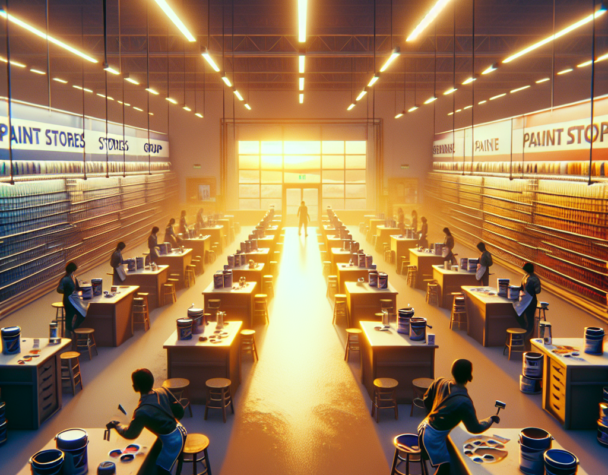
Despite broader pressures, Sherwin‑Williams’ Paint Stores Group—anchored by professional repaints, protective coatings and residential repaint—continues to deliver relatively resilient performance. This segment’s steady cash generation provides a buffer against volatility in industrial and architectural segments that are more sensitive to cyclical construction activity.
What This Means for SHW
- Balance‑sheet flexibility improved: the credit extension reduces near‑term refinancing risk and eases liquidity concerns tied to higher funding costs.
- Short‑term earnings upside is muted: cautious guidance and rising input costs suggest limited EPS expansion in 2026 absent stronger demand or faster cost offsets.
- Operational tightening is underway: store consolidations and efficiency measures aim to protect margins while management navigates acquisition integration and commodity pressure.
Conclusion
Recent, concrete moves by Sherwin‑Williams—extending a key credit commitment, closing select stores and guiding conservatively for 2026—reflect a company emphasizing financial resiliency and margin protection over aggressive growth in the near term. Strength in the Paint Stores Group helps stabilize results, but the return of tariff‑related raw material pressure and integration expenses keeps upside limited. Investors and stakeholders should expect management to prioritize liquidity, disciplined cost control and targeted pricing to navigate the current crosswinds.