
Starbucks Rolls Out Low-Cost Stores, New Espresso!
Mon, March 23, 2026Starbucks Rolls Out Low-Cost Stores, New Espresso!
Introduction
Starbucks (SBUX) has spent the past week turning strategy into concrete moves: a targeted product release, accelerated café prototyping, and investment in faster espresso technology. For investors focused on the Nasdaq‑100 coffee giant, these are not cosmetic changes—they represent a coordinated push to improve customer experience, lower unit costs, and drive growth in foot traffic and margins.
What Happened This Week
New product push: a lower‑sugar Premium Chai
Starbucks introduced a Premium Chai blend that contains about 2 grams of sugar sourced from honey and is designed for app-driven customization. This fits squarely within the company’s broader effort to win back frequency through differentiated menu items that emphasize personalization and perceived health benefits—two attributes that matter to core urban and suburban customers.
Store format evolution: smaller, hospitality-focused prototypes
Management confirmed plans to open a substantial number of smaller, lower-cost U.S. stores in the coming years—targeting roughly 175 openings in 2026 and hundreds more through 2028. These formats retain seating and drive-thru access but require less capital to build and operate. The idea is to expand presence in neighborhoods and high-frequency locations without the expense of full-size builds.
Operational Upgrade: Faster Espresso Machines
Why equipment matters
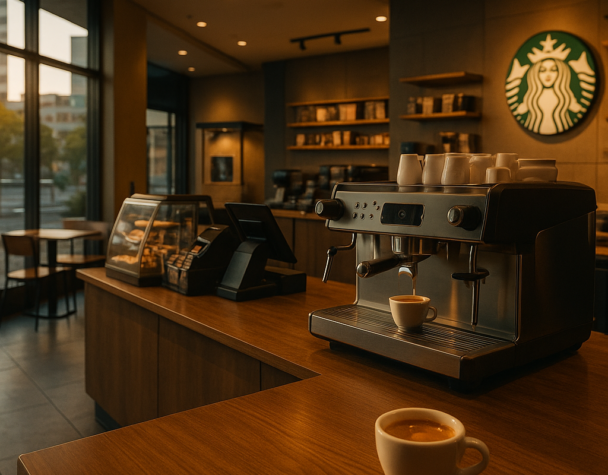
Starbucks plans to deploy next‑generation espresso machines by 2027 that double shot capacity and cut pull time in half. Faster, higher-capacity machines improve throughput, reduce lines, and lower labor intensity per beverage—concrete operational levers that can lift store-level profitability, particularly in high-volume locations.
Investor implications
Together, smaller formats and faster machines act like a one-two punch: the former lowers capital intensity per new store while the latter boosts sales capacity inside existing stores. For shareholders, that combination can translate into faster unit-level ROI and more scalable growth of store economics—two drivers that support higher long-term free cash flow for SBUX.
Context in Hospitality and Technology
Broader hospitality trends intersect with Starbucks strategy
While Starbucks is a restaurant and retail operator rather than a hotel chain, macro hospitality trends—such as personalization through AI and the premiumization of experiences—are relevant. Greater investment in app customization and targeted menu items aligns Starbucks with rising expectations for personalized service. The rollout of efficient store formats mirrors a hospitality-sector focus on optimizing space and service for shorter, higher-frequency visits.
Why this isn’t speculative
These updates are operational and product moves announced by the company, not forward-looking speculation. The store-count targets and equipment timelines are explicit management signals that can be monitored against actual openings and rollout schedules—metrics investors can track quarter to quarter.
How This Could Affect SBUX Valuation
There are three clear valuation channels:
- Revenue growth: More low-cost stores can raise net new locations and incremental sales without proportionate capital increases.
- Margin expansion: Faster throughput and lower build costs can improve store-level margins and operating leverage.
- Customer lifetime value: Product innovation and app customization can increase visit frequency and AUV (average unit volume).
Analysts will likely model a modest lift to same-store sales and unit economics if openings and equipment deployment follow through—particularly in densely populated U.S. and travel-adjacent locations where throughput matters most.
Conclusion
Last week’s announcements are tangible steps in Starbucks’ multi-year strategy: leaner store prototypes, faster bar technology, and targeted menu innovation. These decisions are operationally focused and measurable, making them meaningful for investors assessing near- to medium-term improvements in revenue per store and margin resilience. For SBUX holders, the coming quarters will be revealing as the company converts strategy into actual openings, equipment rollouts, and measurable changes in customer behavior.
Note: Investors should monitor quarterly disclosures and store opening cadence to validate execution against the company’s stated timelines.