
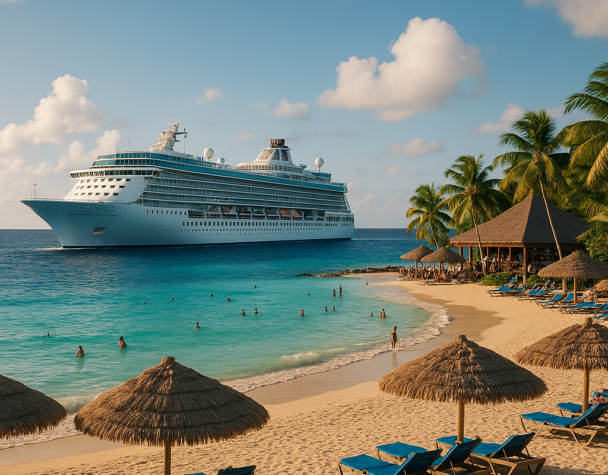
RCL Expands Fleet: 2 Discovery Ships, Beach Clubs!
Tue, March 24, 2026RCL’s strategic push: new ships, stronger guidance, and land-based offers
Royal Caribbean (RCL) made several concrete moves this week that matter to shareholders and active investors. Management finalized firm orders for two new Discovery Class cruise ships, provided upbeat Q1 2026 earnings guidance, and accelerated the rollout of branded shore-side experiences such as Royal Beach Club Santorini. Taken together, these actions underscore a multi-year growth trajectory while highlighting specific near-term variables that could influence results.
Firm Discovery Class orders — what was announced
Royal Caribbean signed firm contracts with the shipyard to build two Discovery Class vessels, with options for up to four additional ships. The delivery schedule puts the first unit in 2029 and the second in 2032. This commitment follows the company’s recent Icon-class investments and signals continued fleet modernization and capacity expansion over the next decade.
Investor implications of the newbuilds
- Growth narrative: Adding Discovery Class capacity reinforces RCL’s long-term revenue growth story and its push into differentiated onboard experiences.
- Capital allocation: Newbuilds are capital-intensive and require multi-year financing and cash planning. Investors should expect elevated capital expenditures in the medium term tied to ship construction timelines.
- Competitive positioning: The Discovery Class gives RCL another product tier to compete on size, amenities, and itinerary variety versus rival lines.
Q1 2026 guidance — concrete numbers to note
Royal Caribbean released Q1 2026 guidance projecting adjusted EPS between $3.18 and $3.28. Management also expects net cruise yields to rise roughly 2.4%–2.9% on an as-reported basis (about 1.0%–1.5% in constant currency). Operating costs per available passenger cruise day — excluding fuel — are forecast to increase modestly, in the range of 1.7%–2.2% (0.9%–1.4% CC).
Key headwinds and sensitivities
The company flagged an estimated 30 basis point drag on Q1 results from itinerary adjustments in China, illustrating regional demand sensitivity. While the guidance indicates margin expansion overall, the China itinerary shift is a measurable, near-term factor that can affect yields and occupancy on specific sailings.
Expanding beach clubs and land-based offerings
RCL is ramping up its branded shore-side portfolio. The company confirmed Royal Beach Club Santorini will open in summer 2026, joining earlier initiatives such as the Bahamas beach club launching this December. Management aims to grow from a couple of locations to eight by 2028, extending the Royal Caribbean brand into controlled, onshore revenue streams.
Why land-based assets matter
- Diversification: Branded destinations create ancillary revenue beyond ticket and onboard spend, smoothing seasonality and guest lifetime value.
- Brand extension: Controlled shore experiences enable RCL to deliver consistent guest standards and capture a larger share of port-related spending.
Sustainability trend: alternative fuels on newbuilds
The broader cruise industry is shifting toward alternative fuels, with a notable share of 2026 deliveries designed to operate on LNG or other lower-emission fuels. Royal Caribbean’s recent and upcoming newbuilds align with this trend, supporting the company’s operational efficiency and ESG positioning — factors increasingly considered by institutional investors.
What this means for RCL stock
Collectively, the Discovery Class orders, positive near-term guidance, and beach club expansion provide a substantive operational and strategic update that supports a constructive equity thesis: visible capacity expansion, yield improvements, and revenue diversification. At the same time, investors should account for elevated capex commitments, region-specific itinerary sensitivity (notably the China headwind cited), and modest cost inflation per passenger day.
For investors focused on fundamentals, the week’s announcements offer tangible datapoints — firm ship orders with delivery timelines, explicit EPS guidance ranges, and confirmed land-asset openings — that reduce ambiguity around Royal Caribbean’s multi-year plan while clarifying short-term exposures.
Conclusion
Royal Caribbean’s latest actions are material and actionable: firm Discovery Class orders underline long-term growth intent, the Q1 2026 outlook signals continued margin progress, and the beach club rollouts diversify revenue beyond ship operations. These concrete developments make RCL’s near- to medium-term trajectory clearer for investors, though they come with predictable trade-offs in capital intensity and regional demand sensitivity.
Investors should monitor build financing, execution milestones for the new ships, the performance of initial beach clubs, and regional itinerary developments that could affect yields in upcoming quarters.