
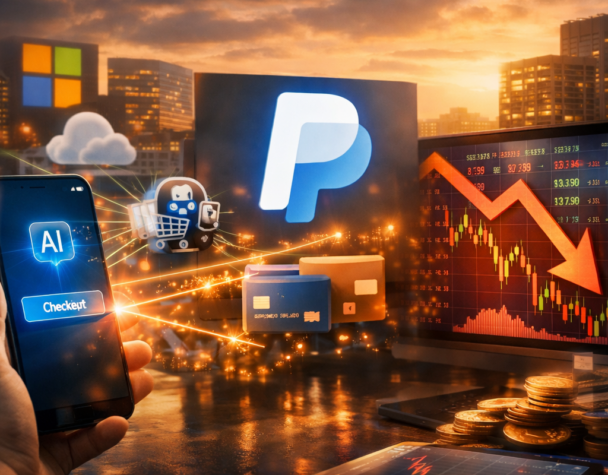
PayPal's AI Checkout Deals Spark Stock Repricing!!
Wed, April 08, 2026PayPal’s AI Checkout Deals Spark Stock Repricing!!
Introduction
This past week produced a cluster of tangible moves that directly affect PayPal (NASDAQ: PYPL). New commercial integrations — with Sabre and Mindtrip in travel, OLB Group’s SecurePay gateway for small and mid-size merchants, and continuing embedded checkout work with Microsoft and Google — advance PayPal’s strategy to be the payments plumbing inside AI-driven commerce. At the same time, disappointing quarterly results and soft guidance have accelerated a valuation reprice that has left the stock trading near multi-year lows. The following unpacks the events, their immediate impact on PYPL, and what investors should monitor next.
Partnerships Accelerating Embedded, AI-Driven Checkout
Sabre + Mindtrip: agentic AI travel payments
PayPal’s announced collaboration with Sabre and travel startup Mindtrip aims to embed PayPal wallet, Pay Later and other options into an “agentic AI” travel booking flow, initially for flights with a planned Q2 launch. By keeping discovery, booking and payment inside a conversational interface, PayPal removes friction and captures more transaction touchpoints — a direct play for higher take-rates on bookings processed through its rails. The market reaction was measured but net negative in the short term (~2.5% intraday dip), reflecting investors’ focus on near-term earnings versus long-term product optionality.
OLB Group: widening access to SMB merchants
On February 17, OLB Group announced it will embed PayPal Checkout, Venmo, Pay Later and PayPal Credit into its SecurePay gateway for small- and mid-sized merchants. This phased rollout simplifies integration for merchants who previously faced technical or cost barriers, potentially increasing PayPal’s share of commerce flows in the SMB segment — a channel that can drive meaningful incremental volume over time if adoption scales.
Microsoft Copilot Checkout and Google UCP support
PayPal’s technical work with Microsoft to enable Copilot Checkout and its support for Google’s Universal Commerce Protocol (UCP) put PayPal squarely inside AI-assisted shopping experiences. Those integrations aim to eliminate redirect-based checkout friction, enabling purchases directly within AI chat or search flows. Such placements matter because they influence where consumers complete transactions — and better placement tends to boost conversion and wallet usage.
Earnings Pressure and Valuation Reset
Despite strategic progress, recent financials and guidance have been adverse catalysts. The company’s weak Q4 results and cautious 2026 outlook precipitated a sharp share-price correction earlier, with reports of an ~18% sell-off tied to that update. PayPal now trades at a forward P/E in the mid‑single digits (about 9.5x), a substantial discount to historical multiples and to many payments peers. That valuation reset reflects investor skepticism around growth reacceleration and execution risk under new leadership.
Near-Term Catalysts and What Moves PYPL
- Execution on integrations: Early merchant rollout metrics from OLB and adoption rates for Copilot Checkout/UCP placements will be critical. Strong conversion lifts or merchant sign-ups would validate the thesis that embedded AI commerce materially increases transaction volume.
- Product monetization: Growth in Pay Later adoption inside AI flows and travel bookings (where higher average order values are common) would help expand take-rates and ARPU.
- Earnings cadence: Any sequential improvement in TPV growth, margin stabilization, and cash flow will influence whether the market maintains the current valuation discount.
- Competitive responses: How Apple, Visa/MC, Stripe and BNPL players respond to AI-embedded checkout will shape PayPal’s moat. Defensive or counter integrations could compress near-term upside.
Conclusion
This week’s developments create a clearer strategic narrative: PayPal is actively positioning itself as the embedded payments backbone for AI-driven commerce, from travel bookings to conversational search checkouts. Those partnerships are concrete steps that could drive durable transaction growth if adoption scales. However, near-term market sentiment remains dominated by recent earnings disappointment and a pronounced valuation reset. For investors, the trade-off is between discounted current valuation and execution risk: material adoption signals from the recent integrations would likely be the catalyst that re-rates the stock upward, while continued top-line headwinds could keep multiple compression in place.
Note: The article synthesizes reported events and market reactions from the past week and is intended to summarize tangible developments that affect PYPL. It does not provide investment advice.