
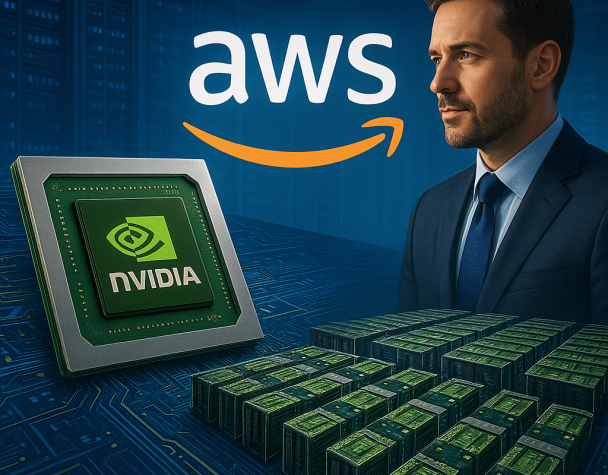
Nvidia’s AI Compute Expansion: AWS to Deploy Over 1 Million GPUs, Enhancing Its Role in the DJ30
Mon, August 24, 2026Nvidia is poised to deepen its leadership in AI infrastructure following a joint announcement with Amazon Web Services (AWS) that AWS will deploy more than 1 million Nvidia GPUs this year, spanning the Blackwell and Rubin architectures. The GPUs will support agents and large-scale computing workloads across AWS’s global cloud regions, marking a significant expansion of Nvidia-powered AI compute capacity. This development occurred at GTC 2026 and was confirmed through Nvidia’s and AWS’s announcements earlier this year.
What Happened, and When
At the GTC 2026 event earlier this year—held in March—Nvidia and AWS revealed that AWS will begin deploying over 1 million Nvidia GPUs, including the Blackwell and Rubin architectures, across its global cloud infrastructure. The deployment is underway this year, although precise regional rollout timelines were not specified in the announcements. The news was first shared in Nvidia’s blog updates and further detailed in follow-up media coverage in the days after GTC.
Context for Investors
This expansion reflects Nvidia’s continued dominance in supplying AI compute infrastructure and the growing reliance of hyperscalers like AWS on its GPU technologies. The Blackwell series powers intensive training workloads, while the Rubin architecture optimizes inference and agentic AI—both critical for emerging AI applications.
Meanwhile, Nvidia’s stock (NVDA, Dow Jones Industrial Average constituent) was trading at $214.72 as of August 21, reflecting a recent decline of 1.69%. While the AWS deployment may boost investor sentiment over the medium term, no immediate causation between this event and Nvidia’s share price has been established by market reporting. The stock’s near-term movement could be influenced by a range of macro factors beyond this specific development.
Why It Matters
For stock investors, the AWS deployment underscores the sustained commercial demand for Nvidia’s advanced compute platforms, reinforcing its strategic relevance in the AI era. This could contribute to long-term revenue stability and potential upside in enterprise and cloud segments.
However, without clear, contemporaneous evidence linking Nvidia’s share price movement to the AWS announcement, investors should see this as a strategic signal rather than a confirmed market catalyst. Other influences—macro conditions, earnings updates, or sector rotations—may be driving recent stock performance more directly.
Next Steps to Watch
- Monitor Nvidia’s upcoming earnings releases for any material commentary or modeling on revenue from enterprise or cloud AI segments tied to hyperscaler deployments.
- Watch AWS’s cloud infrastructure updates and regional service expansions to gauge the geographic rollout and customer uptake of Nvidia-powered offerings.
- Track analyst reports or investor days for updated forecasts or sentiment adjustments based on this scale of GPU deployment.
As AI continues to drive massive data-center demand, Nvidia’s role as a critical supplier to hyperscale providers like AWS positions it for continued strategic growth. Whether the recent announcement translates into tangible stock momentum will depend on how the narrative unfolds across earnings, infrastructure development, and investor sentiment.