
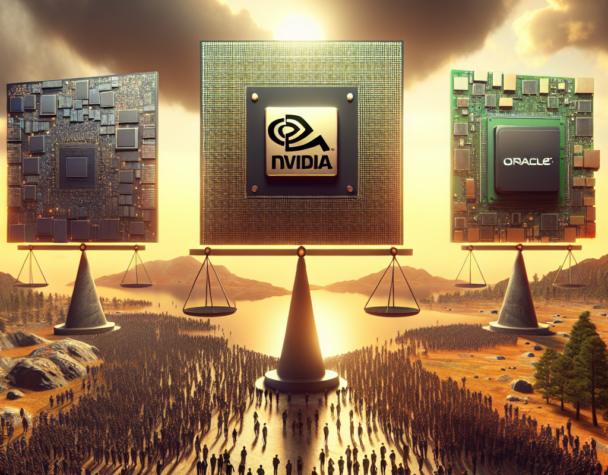
NVIDIA SchedMD Buy, China H200 Surge, Oracle Shift
Wed, December 17, 2025NVIDIA’s Week in Focus: Concrete Moves, Clear Impacts
The past week brought a string of tangible events that directly affect NVIDIA (NVDA) — not speculation about future trends but concrete announcements and customer actions. Three items stand out: NVIDIA’s acquisition of SchedMD, a resurgence of Chinese demand for H200 AI accelerators after regulatory easing, and Oracle’s public embrace of chip neutrality alongside a significant AMD GPU commitment. Each development has distinct implications for revenue, product positioning, and investor expectations.
SchedMD Acquisition: Strengthening the HPC & AI Stack
NVIDIA’s purchase of SchedMD — the team behind the open-source Slurm workload manager widely used in high-performance computing (HPC) environments — is a direct, actionable expansion of its software and orchestration capabilities. This is not a speculative partnership: integrating a proven scheduler into NVIDIA’s stack accelerates adoption of its compute platforms inside research centers and enterprise clusters.
Why SchedMD matters
- Slurm is the de facto job scheduler for many supercomputers and HPC clusters; owning the maintainers shortens integration cycles and reduces friction for customers migrating to NVIDIA’s AI-focused infrastructure.
- Software control increases stickiness: customers running mission-critical workloads are less likely to switch away if NVIDIA controls closer-to-metal orchestration and support.
- For investors, this is a strategic, near-term earnings-enabling move: tighter software integration can raise effective utilization of NVIDIA GPUs across HPC and AI, improving realized revenue per system.
China H200 Demand: Supply and Revenue Implications
Following a U.S. relaxation of export limitations, Chinese hyperscalers and large tech firms renewed purchases of NVIDIA’s H200 accelerators. These are Hopper-generation parts that, while not the very newest Blackwell chips, remain highly capable for large-scale enterprise AI workloads. The immediate result: a tangible uplift in order velocity and near-term revenue expectations.
What this means for NVDA
- Near-term revenue boost: renewed large orders from companies like Alibaba and ByteDance translate into recognized sales and better-period results compared with purely forward-looking guidance.
- Supply-chain pressure: NVIDIA will need to coordinate with TSMC and contract manufacturers to scale output without eroding gross margins via spot supply premiums or expediting costs.
- Geopolitical caveats remain: while approvals eased, future policy shifts could still affect shipments—so the demand is real but not unconditional.
Oracle’s Chip Neutrality and AMD Deployment
Oracle’s recent guidance and strategic update went beyond a simple earnings miss: the company signaled higher capital expenditure plans and an explicit move toward “chip neutrality,” committing to both NVIDIA and AMD accelerator deployments. Oracle’s plan includes a sizeable rollout of roughly 50,000 AMD Instinct MI450 GPUs in 2026 alongside continued NVIDIA use.
Investor implications of Oracle’s move
- Differentiation pressure: multi-vendor cloud strategies by major enterprises reduce single-supplier leverage, making long-term server wins more competitive and margin-sensitive for NVIDIA.
- Revenue mix effects: while Oracle’s AI capex rise can benefit overall data-center demand, the split with AMD means some capacity that might once have been NVIDIA’s is now shared.
- Not a fatal blow: NVIDIA’s lead in software, developer ecosystem, and performance still offers pricing power, but customers’ explicit neutrality requires continued technology and commercial defenses.
Stock Reaction and Near-Term Catalysts
NVDA’s share price moved modestly during the week as investors digested these developments. Short-term swings reflect the interplay between concrete revenue signals (China H200 orders, SchedMD integration) and competitive headwinds (Oracle’s AMD commitment). Analysts are watching for two specific catalysts:
- Blackwell NVL72 deployments: planned supercluster rollouts in early 2026 are viewed as a technical and commercial inflection point. Successful early deployments could re-accelerate premium demand.
- Production scaling with TSMC: the company’s ability to ramp chip volumes without margin-dilutive measures will determine how much near-term order flow converts into profitable revenue.
Bottom Line
This week’s news is notable because it’s concrete and actionable. The SchedMD acquisition deepens NVIDIA’s software moat in HPC and AI orchestration. Renewed H200 demand from China provides immediate revenue tailwinds, albeit with geopolitical uncertainty. Oracle’s chip-neutral stance and large AMD deployment pose a measurable competitive risk that could temper some growth assumptions. For investors, these developments warrant a recalibration of both upside catalysts (Blackwell rollouts, software monetization) and downside sensitivities (multi‑vendor cloud strategies, supply scaling).
Overall, recent events sharpen the investment thesis: NVIDIA’s technical and software expansion supports durable demand, while cloud customers’ diversification requires continued execution on product leadership and ecosystem integration to sustain premium valuation.