
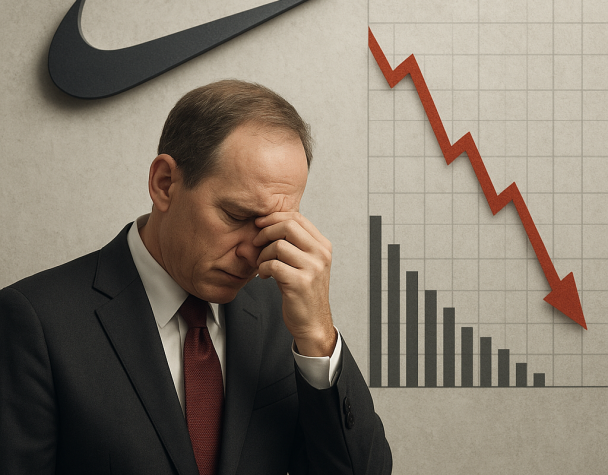
Nike to Exit S&P 100 After Nearly 18-Year Run as Market Value Crumbles
Tue, September 08, 2026Nike (ticker: NKE) is poised to be removed from the S&P 100 index, effective before the market opens on Monday, September 21, 2026, marking the end of an almost 18‑year tenure in the elite benchmark, according to S&P Dow Jones Indices. The company will, however, remain in the broader S&P 500 index.
Exit Reflects Prolonged Stock Decline
The removal is part of the index’s quarterly rebalance, an automated process reflecting companies’ relative size and liquidity. Nike’s market capitalization has plunged to around $57 billion—down more than $220 billion from its peak near $264 billion in late 2021—making it among the smaller names in the S&P 100 by today’s standards.
The stock closed at $38.40 on September 4, 2026, its lowest level in approximately 12 years, and trading within roughly a dollar of its 52‑week low. Over five years, Nike has tumbled about 76–78% from its 2021 high. In contrast, the S&P 100 index has gained approximately 83% over the same period, underscoring the mismatch in performance.
who Takes Nike’s Place?
Four technology companies are stepping into the vacated S&P 100 slots: Dell Technologies, Palo Alto Networks, Arista Networks, and SanDisk. These firms—promoted from the broader S&P 500—reflect the index’s growing tilt toward technology sectors.
Index Mechanics vs. Investor Impact
While the exit carries symbolic weight, the practical impact on Nike’s stock may be muted. Only funds tracking the S&P 100—such as the iShares S&P 100 ETF, which holds just over $20 billion in assets—are forced to sell shares. In contrast, S&P 500 index funds, including the SPDR S&P 500 ETF Trust (SPY), which manages more than $800 billion, are not affected.
What This Signal Means for Nike
The move underscores broader investor confidence issues amid Nike’s ongoing turnaround challenges. Weakness in key areas such as Greater China, declines in direct-to-consumer and digital channels, and a stagnant $46–47 billion revenue base in fiscal 2026 have weighed heavily on its valuation.
Although management has begun pivoting—repairing wholesale partnerships, clearing excess inventory, and reinvigorating product innovation—the removal serves as a public confirmation that Nike has yet to meet market expectations for sustainable recovery.
Conclusion
Nike’s departure from the S&P 100 on September 21 does not affect its standing in the S&P 500, but it does highlight just how far the company has fallen in market prominence. For investors, this represents both a stark milestone and a potential inflection point: the stock is exiting the blue-chip club but may also have priced in much of its downside. Watch for whether the renewed strategic focus under CEO Elliott Hill will be enough to restore investor faith—or if the company will remain in the shadows of its tech-heavy replacements.