
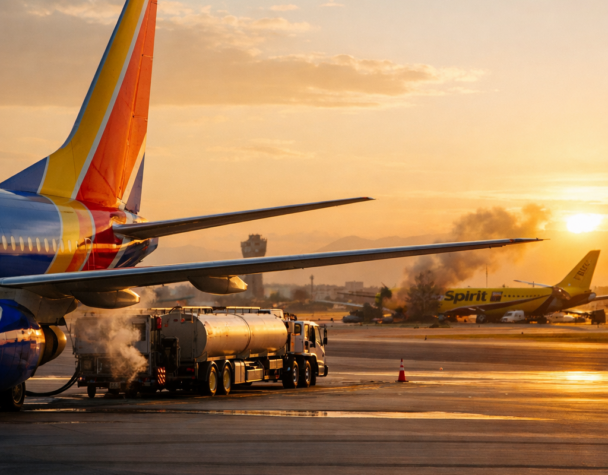
Southwest Rally, Fuel Risks, and Spirit Fallout Q1
Tue, May 05, 2026Southwest Rally, Fuel Risks, and Spirit Fallout Q1
Southwest Airlines (ticker: LUV) entered the week with tangible momentum — a return to quarterly profit, healthy revenue growth and aggressive capital returns — yet the stock remains sensitive to two concrete forces: fuel-price volatility and the sudden collapse of Spirit Airlines. These developments have immediate operational and financial implications for LUV that investors should weigh carefully.
Earnings and financial performance
Key Q1 results
Southwest reported roughly $7.2 billion in operating revenue for Q1 2026, a double-digit increase year over year, and returned to net profitability with about $227 million in net income (roughly $0.45 per share). Operating margin expanded noticeably to 4.6% and operating cash flow approached $1.4 billion. Management also executed meaningful shareholder returns, deploying over $1.3 billion through buybacks and dividends during the quarter.
Guidance highlights and cost pressures
For Q2 the company guided adjusted EPS of $0.35–$0.65, projected RASM (revenue per available seat mile) growth in the mid-teens, and flagged CASM‑X (unit costs ex-fuel) rising roughly 3.5%–4.0%. Those figures underscore durable top-line strength but also show that cost compression is not guaranteed. With Southwest largely out of fuel hedges, upward movements in jet fuel will flow more directly to margins, a structural vulnerability that investors priced in after results: LUV slipped modestly following the release despite the positive underlying trends.
Industry shock: Spirit Airlines collapse
Immediate market ripple effects
The abrupt failure of Spirit Airlines reshuffled demand and capacity in the ultra-low-cost carrier (ULCC) segment. Competitors responded quickly, offering discounted rescue fares and stepping up hiring to accommodate displaced passengers and staff. For Southwest, the Spirit void creates an immediate opportunity to capture incremental leisure demand and selectively expand into vacated routes.
Opportunity versus execution risk
Gaining share from Spirit is not automatic. Capturing that demand requires nimble network planning, targeted pricing and swift crew/aircraft deployment. Executed well, these moves can add incremental revenue and stronger unit revenue in the near term; executed poorly, they can add complexity, margin dilution and operational strain. Think of the situation like a pop-up store opening in a neighborhood after a major chain closes — there’s traffic to capture, but the inventory, staffing and customer experience must be ready immediately.
What directly affects LUV stock now
Short-term catalysts
- Fuel price swings: With minimal hedges, LUV’s margins are exposed to jet fuel increases. A persistent uptick would pressure guidance and investor sentiment.
- Execution on Spirit opportunities: Announcements of new routes, capacity redeployments or fare strategies that materially improve unit revenues would be positive catalysts.
- Quarterly cadence: Upcoming monthly traffic and revenue updates will reinforce or challenge current guidance ranges.
Balance-sheet and shareholder actions
Strong operating cash flow and the recent buyback activity are supportive fundamentals. Continued buybacks or special returns can provide a floor for the share price, but these moves must be balanced with liquidity needs in a fuel-volatile environment.
Investor takeaways
Southwest’s Q1 shows that structural changes in its revenue mix and disciplined cost control are producing results. However, two tangible risks remain: fuel costs (given limited hedging) and the operational demands of rapidly absorbing market share left by Spirit. For investors this creates an asymmetric profile — upside if Southwest converts Spirit’s collapse into durable revenue gains without incurring elevated costs, and downside if fuel moves or integration friction erode margins.
Positioning should reflect time horizon: shorter-term traders will focus on oil trends and monthly revenue prints; longer-term investors should monitor route additions, unit revenue trends and the company’s ability to sustain shareholder returns while preserving liquidity.
Conclusion
Last week’s concrete events — a better-than-feared Q1, active capital deployment, and the unexpected exit of Spirit Airlines — give LUV a clear narrative: execution-driven recovery tempered by commodity exposure and integration risk. Those are not vague headwinds but measurable, monitorable factors that will drive LUV’s next moves and investor returns.