
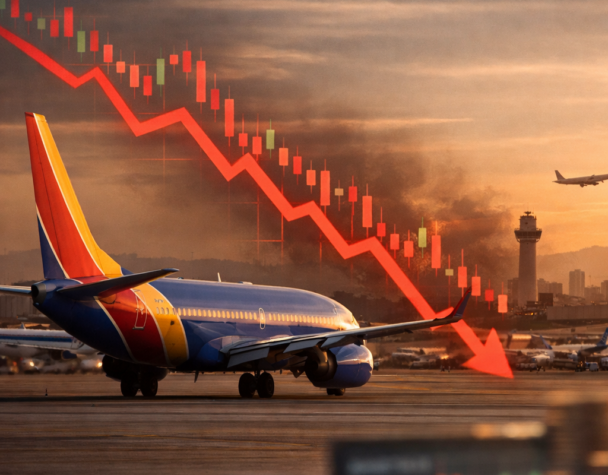
Southwest LUV Slides After Big Fuel-Hedge Exit Now
Tue, April 07, 2026Introduction
Southwest Airlines (LUV) moved to the front of investor headlines this week as a string of concrete events — most notably its exposure to rising jet fuel prices, analyst target cuts, and a revised earnings outlook — converged to pressure the stock. For investors focused on fundamentals and near-term catalysts, the combination of unhedged fuel exposure and downward guidance has materially changed the risk/reward profile for LUV.
Why fuel strategy matters now
Southwest exited its fuel hedging program in early 2025, leaving the carrier fully exposed to spot jet fuel prices. That strategy looked reasonable in a stable-cost environment, but a recent surge in jet fuel — driven in part by geopolitical tensions — has magnified operating cost volatility across the industry. Unlike peers that retained partial hedges, Southwest faces dollar-for-dollar margin erosion as fuel climbs.
Immediate impact on profitability
The practical result: analysts and investors recalculated earnings models to reflect higher unit costs. Management’s revised guidance trimmed 2025 EBIT to roughly $500 million from a previous $600–$800 million range, increasing the probability of an earnings miss versus prior consensus. With EBIT compression, free cash flow and return-to-shareholders assumptions need reworking, which is already reflected in a weaker stock price.
Analyst moves and share-price reaction
Concrete sell-side actions this week reinforced the negative sentiment. Several firms lowered price targets and ratings after the guidance change:
- UBS cut its 12-month target, reflecting reduced earnings visibility.
- Susquehanna trimmed its target to a neutral level around $42.
- TD Cowen kept a constructive stance but reduced its upside target to the mid-$40s.
In trading, LUV fell sharply: one notable session in early April saw a roughly 5.8% single-day decline as the market digested the revised outlook and rolling analyst updates. Over the prior month, the stock moved down significantly as fuel-driven margin risk and lower guidance fed through to valuation multiples.
Valuation and peer contrast
Prior to the shock, LUV traded at a premium to some global airline averages, reflecting historical profitability and brand strength. The recent shock has tightened the link between spot fuel and earnings, making that premium harder to justify unless Southwest demonstrates concrete mitigation steps or fuel costs decline. Compared with Delta and United — carriers with more hedging protection or diversified revenue mixes — Southwest’s earnings are now viewed as more volatile.
What investors should watch next
For investors assessing LUV, focus on three measurable signals:
- Fuel-cost trajectory: sustained declines in spot jet fuel would immediately ease margin pressure; conversely, further spikes deepen downside.
- Management actions: any move toward partial hedging, aggressive cost cuts, or stronger revenue initiatives would help stabilize forecasts and investor confidence.
- Quarterly results versus revised guidance: an actual earnings beat (or miss) relative to the new, lower expectations will drive short-term price volatility and may trigger further analyst revisions.
Risk vs potential catalysts
Risks are tangible and near-term: continued high fuel prices, missed guidance, and further downgrades. Potential upside catalysts are equally concrete: defensive hedging reintroduction, better-than-expected operational trends, or meaningful cost reductions that protect margins.
Conclusion
Southwest’s current sell-off is grounded in specific, verifiable developments — chief among them the airline’s unhedged fuel exposure and a downward revision to EBIT guidance — rather than vague speculation. For investors, the immediate task is to monitor fuel prices, management responses, and the next earnings release for evidence of stabilization. Until those variables move in a favorable direction, LUV will likely remain more sensitive to short-term shocks than many of its larger, partially hedged peers.
Disclosure: This article is informational and not investment advice. Investors should perform their own due diligence before making trading decisions.