
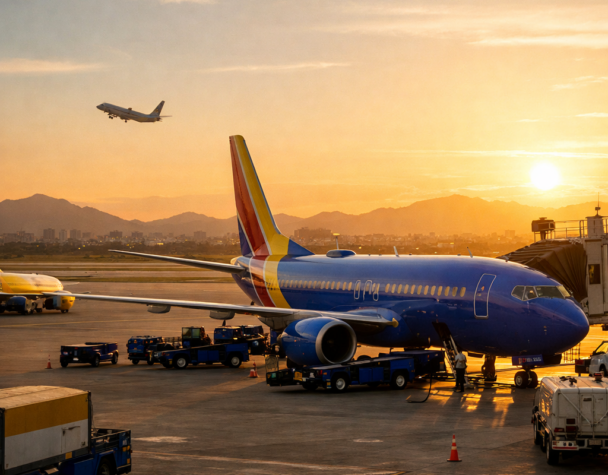
LUV: Southwest Captures Spirit Demand, Outlook Up!
Tue, May 12, 2026LUV: Southwest Captures Spirit Demand, Outlook Up!
Recent, concrete developments in the U.S. airline sector have direct implications for Southwest Airlines (ticker: LUV). Spirit Airlines’ abrupt cessation of operations created an immediate pool of displaced travelers; Southwest responded with targeted fares and benefits that can translate into measurable traffic gains. At the same time, persistent jet-fuel inflation and mixed institutional positioning keep upside conditional on execution. This article summarizes the key events, relevant data points, and implications for investors focused on LUV.
What happened and why it matters
Spirit Airlines halts operations — Southwest’s rapid response
On May 2, 2026, Spirit Airlines stopped operating flights, leaving many passengers needing alternatives. Southwest moved quickly to offer relief: special one‑way fares for affected travelers and status-match options for Spirit elites. The airline set short‑haul fares in the low‑hundreds and longer domestic fares nearer to the $300–$400 range for rebooked customers, aiming to convert stranded demand into booked revenue rather than losing it to competitors or refunds.
Immediate route and revenue implications
Southwest’s route network overlaps Spirit on multiple price‑sensitive domestic corridors. By filling some of the evacuated capacity, LUV can capture incremental passenger volumes and ancillary revenue—particularly on leisure and short‑haul city pairs where Spirit had a strong presence. This is a near‑term tactical benefit: revenue per available seat mile (RASM) can improve modestly if load factors rise without proportional cost increases.
Financial signals and institutional activity
Dividend continuity and brand strength
Southwest declared its consecutive quarterly dividend again in early May, marking its long pattern of returning cash to shareholders. Concurrently, independent measures show Southwest leading economy traveler satisfaction for the fifth consecutive year, reinforcing a service advantage that supports repeat demand and pricing resilience.
Institutional moves: Vanguard trims while others add
Recent 13F filings show Vanguard Group modestly reduced its Southwest position—selling roughly 463,700 shares (about a 0.8% trim), leaving a stake near 60.6 million shares or roughly 11.7% of the company. Other institutions increased or established positions, producing a mixed institutional backdrop. These moves highlight diverging views: some managers are taking profits after recovery rallies, while others are positioning for potential upside from demand gains tied to Spirit’s exit.
Macro headwinds that constrain upside
Jet fuel and operating costs
Across the industry, rising crude and jet‑fuel prices are a tangible, measurable headwind. Several brokerages trimmed near‑term earnings estimates for U.S. carriers because higher fuel costs impair margins even when passenger demand remains healthy. For Southwest, the benefit of incremental passenger capture will be offset to some degree by these cost pressures unless fuel hedges or cost discipline bridge the gap.
Analyst consensus and valuation context
Analysts currently cluster around a “Hold” consensus for LUV, with average targets in the mid‑$40s. That reflects a view of modest upside balanced against execution risk—managing costs, integrating network opportunities, and sustaining customer satisfaction while modernizing fare structures and operational practices.
Investor implications and tactical considerations
For near‑term traders, the Spirit shutdown represents a concrete, observable catalyst that can drive traffic and revenue lift on overlapping routes. For longer‑term investors, the signal is more nuanced: Southwest’s defensive strengths—dividend discipline and top customer rankings—are offset by sector‑wide fuel-cost inflation and the responsibility to translate fleeting demand shocks into durable margin improvement.
- Potential upside: Quick redeployment of capacity to former Spirit routes and capture of price‑sensitive passengers.
- Key risks: Rising jet‑fuel costs, execution of pricing and seating strategy changes, and mixed institutional sentiment.
- Watch points: Quarterly RASM, load‑factor changes on former Spirit city pairs, fuel‑cost guidance, and any follow‑on institutional 13F activity.
Conclusion
Southwest’s prompt reaction to Spirit’s shutdown is a measurable, non‑speculative event that should yield near‑term passenger and revenue gains where networks overlap. That practical upside is tempered by persistent jet‑fuel inflation and mixed sentiment among large holders—factors that keep the stock’s longer‑term appreciation dependent on disciplined cost management and sustained demand conversion. For investors, the current window offers a clear catalyst to monitor, anchored by concrete fare actions, dividend continuity, and empirical customer‑satisfaction strength.