
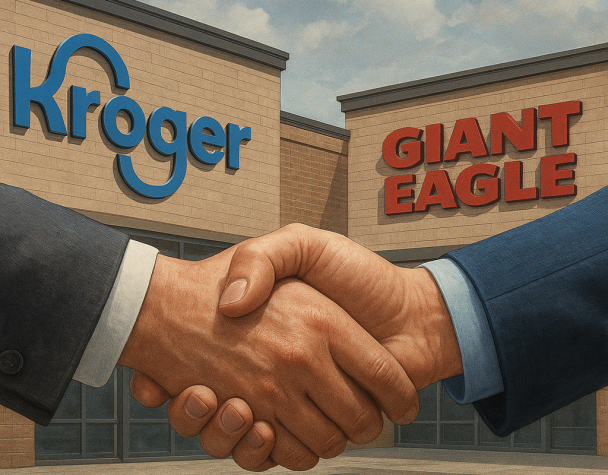
Kroger's Acquisition of Giant Eagle: Strategic Expansion Amid Market Challenges
Tue, July 07, 2026Kroger’s Acquisition of Giant Eagle: Strategic Expansion Amid Market Challenges
On July 1, 2026, Kroger Co. announced its plan to acquire regional supermarket chain Giant Eagle for $1.65 billion. This strategic move aims to bolster Kroger’s presence in the Mid-Atlantic and Midwest regions, marking a significant expansion for the Cincinnati-based grocery giant.
Details of the Acquisition
The acquisition deal comprises $1.25 billion in cash and the assumption of approximately $400 million in liabilities. Giant Eagle, headquartered in Cranberry, Pennsylvania, operates around 200 supermarkets and pharmacies across Pennsylvania, Ohio, West Virginia, Maryland, and Indiana. The company generates annual sales of about $9 billion and employs over 30,000 individuals.
According to Kroger CEO Greg Foran, the acquisition allows the company to “expand our reach into attractive adjacent markets.” Giant Eagle’s CEO, Bill Artman, emphasized the potential for enhanced customer service and growth opportunities for employees under the new ownership.
Market Reaction and Analyst Perspectives
Following the announcement, Kroger’s stock experienced a decline, reaching a 52-week low of $55.56. Investors expressed concerns over the timing and cost of the deal, especially given the stock’s already-depressed valuation. Despite this, BMO Capital reiterated a “Market Perform” rating for Kroger, with a price target of $60. Analyst Kelly Bania noted that the acquisition provides Kroger with meaningful scale in key new markets and is not large enough to impede the company’s ability to execute larger initiatives.
Financial Performance and Industry Context
In its recent earnings report, Kroger reported adjusted earnings per share (EPS) of $1.58, slightly below the consensus estimate of $1.59. Revenue stood at approximately $46.1 billion, a 2.2% year-over-year increase. However, the stock’s decline reflects investor concerns about potential margin pressures due to price-cutting strategies and increased investment in pricing.
The grocery retail sector is witnessing intensified competition, with retailers like Wegmans and Meijer planning entries or expansions in regions where Giant Eagle operates. This competitive landscape underscores the strategic importance of Kroger’s acquisition as it seeks to strengthen its market position.
Conclusion
Kroger’s acquisition of Giant Eagle represents a significant strategic move to expand its footprint in the Mid-Atlantic and Midwest regions. While the deal offers potential growth opportunities, it also presents challenges, including investor concerns over valuation and integration. As the transaction progresses toward its expected closure in 2027, stakeholders will closely monitor its impact on Kroger’s market position and financial performance.
As of July 6, 2026, Kroger’s stock is trading at $58.25, reflecting a slight increase of 0.21% from the previous close. The market’s response to the acquisition and Kroger’s ongoing strategies will be critical in shaping the company’s trajectory in the competitive grocery retail landscape.