
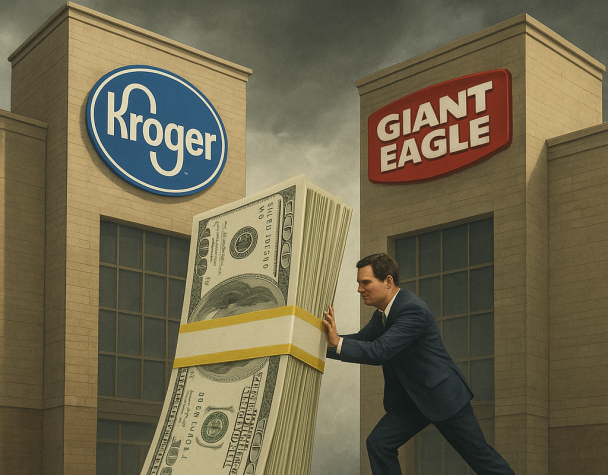
Kroger's $1.65 Billion Acquisition of Giant Eagle: A Bold Move Amid Market Uncertainty
Wed, July 29, 2026Kroger’s $1.65 Billion Acquisition of Giant Eagle: A Bold Move Amid Market Uncertainty
Kroger Co. (NYSE: KR) has recently undertaken significant strategic initiatives, notably the acquisition of regional supermarket chain Giant Eagle for $1.65 billion. This move aims to expand Kroger’s footprint in the Midwest and Mid-Atlantic regions. However, the announcement has elicited mixed reactions from investors and analysts, reflecting broader challenges within the food and drug retail sector.
Acquisition of Giant Eagle
On July 1, 2026, Kroger announced a definitive agreement to acquire Giant Eagle, a regional supermarket chain operating 197 supermarkets and 11 standalone pharmacies across northern Ohio, western Pennsylvania, West Virginia, Maryland, and Indiana. The deal, valued at $1.65 billion—comprising $1.25 billion in cash and the assumption of approximately $400 million in outstanding liabilities—is expected to close in 2027. Giant Eagle generates roughly $9 billion in annual revenue, making it a substantial addition to Kroger’s portfolio. However, the acquisition’s timing and cost have raised concerns among investors, leading to a 2.9% decline in Kroger’s stock during pre-market trading following the announcement.
Market Performance and Analyst Sentiment
Kroger’s stock has experienced volatility in recent months. On June 30, 2026, shares hit a new 52-week low, trading as low as $55.32 before closing at $55.37. This decline occurred despite the company’s efforts to boost sales through customer-focused promotions, including a revamped rewards program and exclusive product lines. Analyst sentiment remains mixed; several firms have adjusted their price targets downward, reflecting concerns about Kroger’s near-term execution and slowing same-store sales momentum.
Financial Performance
In its first-quarter fiscal 2026 results, Kroger reported adjusted earnings per share (EPS) of $1.58 and a 19% increase in adjusted eCommerce sales. However, identical sales without fuel increased only 1.0%, a significant decrease from the 3.2% growth reported in the same quarter the previous year. This slowdown has led investors to question the effectiveness of the company’s turnaround strategies.
Technological Innovations and Regulatory Scrutiny
Kroger has been implementing digital shelf labels across nearly a quarter of its U.S. stores to streamline price changes and reduce labor costs. While this technology aims to enhance operational efficiency, it has attracted scrutiny from federal and state lawmakers concerned about potential surge pricing on groceries. This regulatory attention underscores the delicate balance between innovation and consumer protection in the retail sector.
Conclusion
Kroger’s recent acquisition of Giant Eagle and its technological advancements represent bold steps toward growth and efficiency. However, these initiatives come with challenges, including investor skepticism, market volatility, and regulatory scrutiny. As Kroger navigates these complexities, its ability to integrate new assets, adapt to market demands, and address regulatory concerns will be critical in determining its future success in the competitive food and drug retail landscape.