
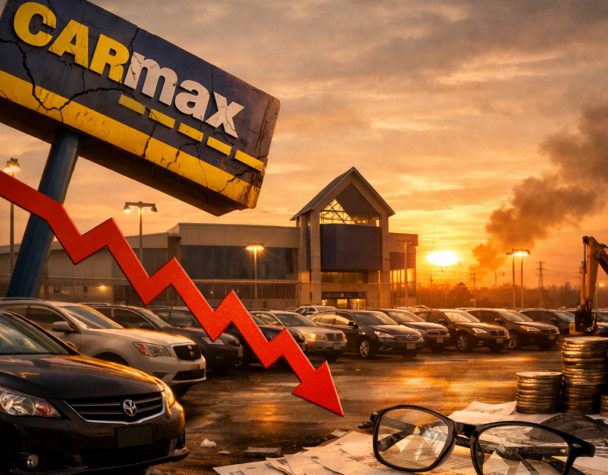
CarMax Hits Rough Patch: Goodwill, Margins, Cuts!!
Tue, May 05, 2026Quick take
CarMax (NYSE: KMX) delivered mixed results that reveal a company repositioning for durability while wrestling with softer used-car economics. A non-cash goodwill impairment and restructuring charges pushed the firm to a GAAP loss, even though adjusted earnings beat expectations. The headline beat didn’t calm markets: investors focused on shrinking per-unit profits, a higher SG&A savings target, a paused buyback program, and a material near-term CapEx commitment.
Q4 results: numbers that mattered
GAAP vs. adjusted earnings
On a GAAP basis, CarMax reported a loss that reflected a roughly $0.99-per-share goodwill impairment plus about $0.20 per share of restructuring costs. On an adjusted basis, earnings per share were about $0.34, above consensus. The gap between GAAP and adjusted results is central to how the market interpreted the release: the impairment signaled a reassessment of long-term assumptions, while the adjusted beat underlined solid operating cash generation before these one-time charges.
Sales and per-unit profitability
Unit volume showed modest resilience—combined retail and wholesale units were up roughly 0.7% year-over-year—yet retail used unit sales and comparable-store used unit sales slipped (around -0.8% and -1.9%, respectively). More revealing was the drop in gross profit per retail unit to approximately $2,115, down by about $207 from the prior year. The decline in per-unit margin is a direct pressure on absolute profitability and free cash flow, especially in a business where volume alone is unlikely to offset narrowing spreads.
Management moves: cost cuts, capex, and buybacks
Accelerating SG&A savings
CarMax increased its SG&A savings target to roughly $200 million by the end of fiscal 2027 (up from $150 million). That move acknowledges margin stress and aims to shore up operating leverage. Execution here will be critical: investors want to see sustainable expense reductions that translate into improved free cash flow rather than one-off accounting fixes.
CapEx and store strategy
Management plans about $400 million in capital expenditures for the upcoming fiscal year, funding a handful of new stores and investments in reconditioning and auction infrastructure. The capex plan signals a long-term belief in scale and omnichannel capabilities, but it raises near-term cash outflow needs at a moment when margins are under pressure.
Share repurchase pause
Although CarMax repurchased roughly $50 million of stock in the most recent quarter, the company has effectively paused further buybacks while preserving authorization. That conservatism is understandable given the goodwill write-down and the desire to preserve liquidity for operational priorities.
Market reaction and implications for investors
Investors reacted swiftly: KMX shares fell in the mid-double-digit percentage range following the release. The market’s emphasis was not on the adjusted EPS beat but on evidence of structural margin erosion and the accounting move that acknowledged it. For investors, the story now pivots from growth-at-scale to execution and cash conversion—can cost cuts, operational tweaks, and targeted investments restore sustained margins and free cash flow?
Conclusion
CarMax faces a transitional quarter: the company is taking concrete steps to address shrinking used-car margins, but the goodwill impairment and paused buybacks have increased near-term uncertainty. Key metrics to watch in the coming quarters will be gross profit per unit, realized savings from SG&A initiatives, and the free cash flow impact of the planned $400 million CapEx. For holders of KMX, the outlook depends less on headline adjusted earnings and more on tangible, sustainable improvements in unit-level economics and cash generation.