
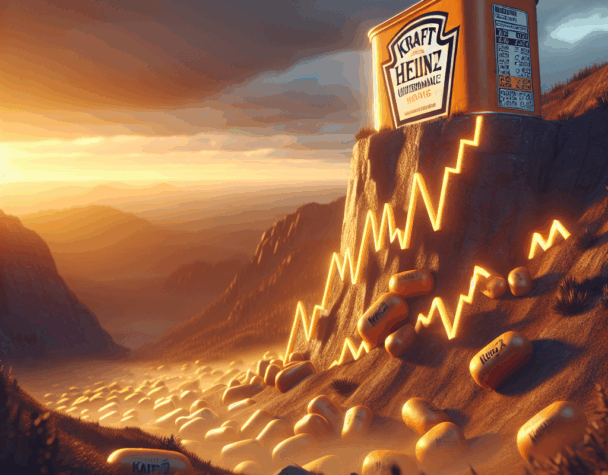
Kraft Heinz Falls Amid Wider Food Sector Weakness.
Fri, December 05, 2025Kraft Heinz Falls Amid Wider Food Sector Weakness.
Over the past week Kraft Heinz Co. (KHC) registered multiple down sessions and thinner-than-normal trading, reflecting a pullback that tracked weakness across food & beverage manufacturing names in the NSDQ100. The moves lacked a single headline catalyst; instead, price action and volume suggest investor caution and sector pressure are weighing on the stock.
Recent Price and Volume Snapshot
Key price moves from the most recent trading days highlight the pattern:
- December 2: KHC slid about 1.62% to close near $24.96, marking a third straight day of losses.
- December 3: The stock rebounded slightly, rising roughly 0.28% to about $25.03.
- December 4: KHC declined roughly 1.76% to close near $24.59 on roughly 11.0 million shares traded—below its 50-day average volume of roughly 15.7 million shares.
Those readings show not only modest price weakness but also a contraction in volume, which often signals hesitation from larger investors rather than a conviction-driven selloff.
Peer Comparison: Broad Weakness, Mixed Leadership
The food & beverage cohort showed similar soft sessions. Coca‑Cola, PepsiCo and Mondelez each posted declines in the same period, while names such as Lamb Weston and other packaged-food companies diverged at times. Notable moves included Conagra, Tyson Foods and McCormick registering down days, underscoring that the softness reflected sector-level dynamics rather than a KHC‑only problem.
What’s Driving the Move
The recent pullback appears driven by a combination of factors that are observable and non‑speculative:
- Lower trading volume: Volume beneath rolling averages points to investor indecision rather than aggressive, news-driven selling.
- Sector headwinds: Packaged‑food names have been sensitive to shifts in consumer spending patterns and margins, causing multiple companies to trade more conservatively.
- Relative performance: KHC’s recent underperformance versus several peers increases scrutiny from active managers and traders who rotate toward perceived defensives or names with clearer near‑term catalysts.
Analogy: Slow Leak, Not a Burst
Think of the current action as a slow leak in a tire rather than a blowout: price is drifting lower and the car is still moving, but the lower volume suggests the major holders are neither fully committed to selling nor buying aggressively. That creates a period of sideways or slightly downward pressure until a clear news event or stronger technical signal appears.
Practical Indicators Investors Should Monitor
- Upcoming earnings and company announcements for any operational updates or guidance changes.
- Volume spikes combined with price direction—these indicate conviction moves versus routine rebalancing.
- Analyst revisions and dividend or capital allocation commentary that can materially alter investor perception of value.
- Peer earnings and input‑cost trends (commodity prices, logistics) that affect margins across the industry.
In the near term, KHC’s path will be tied to both company‑specific signals and broader food & beverage dynamics. The latest week’s action points to caution and consolidation rather than a discrete event-driven collapse.
Conclusion
Kraft Heinz’s recent decline was accompanied by muted volume and mirrored weakness among packaged‑food peers. With no single headline driving the drop, investors should watch earnings, volume behavior and peer news for the next meaningful directional signal.