
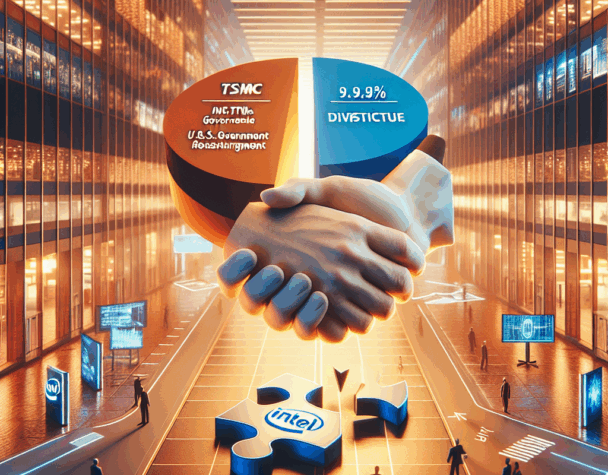
Intel Rally: TSMC Talks and U.S. Stake Boost INTC!
Wed, November 05, 2025Intel (INTC) has been in the headlines this week after a cluster of concrete developments that directly affect the company’s turnaround and investor outlook. Short, verifiable items — reported talks with TSMC about AI chip manufacturing, the U.S. government’s sizeable equity position, the completed partial sale of Altera to Silver Lake, and ongoing restructuring under CEO Lip‑Bu Tan — have combined to move INTC shares on the NSDQ 100. Below is a clear, practical breakdown of what changed, why it matters, and how investors should interpret these items.
What happened this week
Preliminary discussions with TSMC
Reports surfaced that Intel has entered preliminary talks with TSMC about manufacturing AI-focused chips and potentially structuring a strategic partnership or investment. The mere emergence of these discussions triggered a notable intraday price reaction — around a ~5% jump in INTC — because it directly addresses one of Intel’s most public challenges: competing credibly as a foundry for advanced nodes. A deal with TSMC would not be a short-term revenue windfall, but it would signal a practical path to leverage external capacity and shorten Intel’s time-to-revenue on AI silicon designs.
U.S. government equity stake reinforces industrial strategy
Earlier this year the U.S. federal government acquired roughly a 9.9% stake in Intel via combined funding and strategic programs. That ownership position — executed at about $20.47 per share and representing roughly $8.9 billion of support — has continued to be cited this week as a stabilizing factor. For investors, the government stake does two things: it underwrites parts of Intel’s domestic foundry ambitions and reduces the immediate risk that Intel would be forced into distress-driven measures that could erode long‑term value.
Corporate actions tightening Intel’s balance sheet
Altera divestiture and expense discipline
Intel finalized the sale of a majority (51%) of its Altera programmable-chip unit to Silver Lake earlier in the cycle. That transaction remains a live positive in recent analyses: it trims operating expenses, clarifies product focus, and modestly improves cash flow flexibility. Management has stated the deal helped reduce projected operating expenses (a mid‑teens billion dollar target was revised downward), reinforcing the company’s commitment to fiscal discipline during the turnaround.
CEO Lip‑Bu Tan’s restructuring drive
Lip‑Bu Tan’s leadership has been defined by aggressive cost control and organizational flattening. In practice, that means workforce reductions, fewer management layers, and sharper prioritization of projects that either accelerate foundry competitiveness or support data‑center and AI growth. Investors are treating execution — turning those plans into predictable quarterly improvement — as the prime determinant of sustained upside.
Why these items matter for INTC shareholders
Together, these developments change the calculus for Intel in three concrete ways. First, talks with TSMC, even if early, suggest Intel is pragmatic about capacity: it will not wait indefinitely to commercialize advanced chips. Second, the U.S. government stake provides strategic cover and potential access to funding aligned with national chip objectives. Third, the Altera transaction and tighter expense guidance demonstrate management is lowering the threshold for positive earnings surprises.
Short-term price moves this week — spurred by the TSMC reports and favorable geopolitical tone that reduced investor risk aversion — were meaningful but volatile. They reflect sentiment reacting to provable actions rather than rumor. For long-term holders, the headline items reduce execution risk in specific areas but do not eliminate the need for consistent product ramps, foundry client wins, and margin recovery.
Risks and near-term catalysts to watch
- Confirmation of any formal agreement with TSMC — terms, scope and timing will determine materiality.
- Quarterly earnings and updated guidance showing expense reductions translating into operating-profit improvement.
- Progress on advanced node manufacturing (18A and beyond) and the ability to attract third‑party foundry customers.
- Regulatory or geopolitical shifts that could affect cross‑border chip flows or government support programs.
Investors following INTC on the NSDQ 100 should focus on verifiable milestones: signed agreements, quarterly results, and production ramps. Sentiment-driven moves are useful, but execution will determine whether these recent positives sustain a multi-quarter recovery.
Conclusion
Over the past week Intel’s shares have responded to a set of concrete developments that sharpen the company’s turnaround narrative. Preliminary talks with TSMC introduced a credible path for expanding manufacturing capacity for AI chips, while the U.S. government’s roughly 9.9% equity stake continues to underwrite Intel’s domestic foundry ambitions. The Altera divestiture and CEO Lip‑Bu Tan’s cost-cutting measures reinforce tighter expense control and clearer strategic focus. Together, these items reduce several execution risks and have driven meaningful, if volatile, upside in INTC on the NSDQ 100. The near-term outlook will hinge on deal confirmations, quarterly results that show expense-to-profit translation, and tangible progress at advanced process nodes. Investors should prioritize verified milestones over sentiment swings when assessing Intel’s recovery trajectory.