
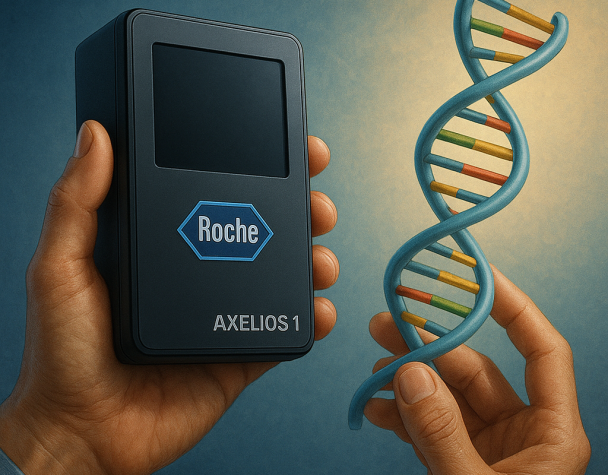
Roche Launches AXELIOS 1, Challenging Illumina’s Dominance in Gene Sequencing Market
Sat, September 05, 2026Roche introduced its next‑generation sequencing platform AXELIOS 1 in late June, aiming to erode Illumina’s long-standing dominance in the $7.3 billion next-generation sequencing (NGS) market. The launch, confirmed on June 29, 2026, marks Roche’s most significant move yet to compete in the gene sequencing space.
The AXELIOS 1 platform is built on Roche’s proprietary Sequencing-by-Expansion (SBX) technology, which converts DNA or RNA into longer “Xpandomer” molecules. These are read through nanopores on a reusable CMOS chip, allowing for same-day, whole-genome sequencing in research workflows. The system promises improved accuracy, speed, flexibility, scalability, and cost efficiency, with early validation from institutions such as Broad Clinical Labs and the Hartwig Medical Foundation. Roche also partnered with 10x Genomics and Google DeepVariant to support broader use cases and integration with analysis tools. However, the platform remains limited to research use only and is not yet cleared for clinical diagnostics.
Initial deployment focuses on academic and research institutions, with Roche targeting the placement of approximately 100 AXELIOS 1 machines in its first year. Pricing is approximately $750,000 in the U.S., compared to Illumina’s NovaSeq X systems, which range from around $985,000 to $1.25 million. Analysts characterize Roche’s strategy as a gradual bid for market share rather than a disruptive takeover, given Illumina’s estimated ~70% market share in NGS systems.
Roche’s launch underscores its ambition to build a new sequencing franchise capable of generating more than CHF 1 billion (roughly US$1.1 billion) in annual revenue over time. Though still early, this represents a notable challenge to Illumina.
Why This Matters for Illumina
Although Roche’s AXELIOS 1 will not immediately erode Illumina’s leadership, the move is significant:
- It introduces credible competition in a space long dominated by Illumina’s high-performance platforms.
- Lower pricing for AXELIOS 1 may appeal to cost-sensitive research labs, especially with recurring consumable costs factored in.
- Partnerships with leading genomic institutions and developers position Roche for broader acceptance and ecosystem support.
What’s Next
Illumina retains a strong hold on the market, buttressed by its ecosystem and installed base. But investors should watch:
- Early customer feedback on AXELIOS 1’s performance and operational ease versus existing Illumina platforms.
- Roche’s timeline for scaling beyond research settings, including potential clinical validation.
- Illumina’s response, whether through pricing adjustments, new product innovation, or partnership strategies.
As of September 4, 2026, Illumina’s stock (ILMN) traded at 218.22, up 0.68%, reflecting underlying stability despite emerging competitive pressures. While Roche’s move may not immediately impact mid-term revenue, it signals a turning point with potential longer-term implications for Illumina’s market share and strategic positioning.