
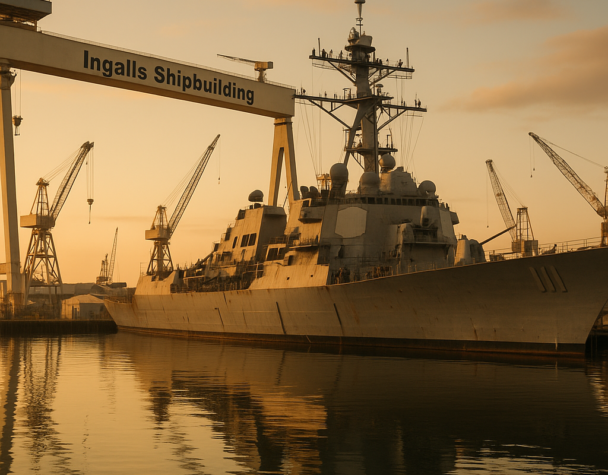
HII Upside: Historic Ingalls Wage Deal Fuels Stock
Mon, March 23, 2026HII Upside: Historic Ingalls Wage Deal Fuels Stock
Introduction: Huntington Ingalls Industries (NYSE: HII) recorded a pivotal operational development this week when Ingalls Shipbuilding union members ratified a new collective bargaining agreement that delivers substantial, multi-year wage increases. That agreement, together with recent strong quarterly results and a major SHIELD contract opportunity, creates a clear set of trade-offs for investors: higher labor costs now versus reduced execution risk and potential higher throughput going forward.
Major facts investors need to know
What the Ingalls agreement contains
On March 12, 2026, Ingalls Shipbuilding workers ratified a deal that provides an immediate base wage increase of at least 18%, with total wage growth of roughly 35%–47% through March 8, 2031. Management described the pact as the largest single wage increase in Ingalls’ history. That scale of adjustment materially raises HII’s long-term labor commitments for the Gulf Coast yard.
Recent financial and contract context
HII’s strong financial momentum leading into the agreement is meaningful context. In the company’s latest quarter, revenue rose about 15.7% year-over-year to roughly $3.48 billion, and adjusted EPS climbed to about $4.05—up near 29% from the prior year. Separately, HII’s Mission Technologies business was positioned with a major SHIELD IDIQ opportunity carrying a reported ceiling near $151 billion, expanding long-term addressable work in missile defense, directed energy, and related systems integration.
What this means for operations and the stock
Higher labor cost vs. improved throughput
The immediate impression is a higher cost base: contractually higher wages will put pressure on margins unless offset. But wage increases can also reduce turnover, improve morale, and shorten the time lost to recruiting and training. For complex programs such as destroyers and carriers, skilled labor stability translates into fewer scheduling slips and lower rework—effectively acting like an investment in execution. Think of the yard as a production line where one highly experienced welder saved from leaving can prevent downstream quality headaches that would cost multiples of their annual pay.
Cash flow and margin considerations
Near term, expect upward pressure on operating costs and possibly adjusted margins in the shipbuilding segment until productivity gains materialize. Over a multi-year window, if throughput rises and schedule reliability improves, the company can recover margin via better absorption of fixed costs and fewer contract penalties or cost-to-complete adjustments. Investors should watch HII’s commentary on unit labor hour trends, overtime usage, and any contract price adjustments or escalation mechanisms that may mitigate wage-driven cost growth.
Investor implications and how to monitor risk
Balance sheet and free cash flow impact
HII’s healthy recent earnings and backlog provide a buffer, but the speed at which operational improvements offset higher wages will drive free cash flow outcomes. Track quarterly operating cash, capital expenditure plans, and any changes to working capital tied to production ramp-ups. If the company can convert backlog into on-time deliveries, the free cash flow profile should remain resilient.
Stock catalysts to watch
- Quarterly commentary on labor productivity (unit labor hours, turnover rates).
- Delivery cadence and on-time completion metrics for high-value platforms.
- Margins in the shipbuilding segments vs. prior quarters.
- Progress or awards tied to the SHIELD IDIQ pipeline and Mission Technologies bookings.
Conclusion
The Ingalls wage agreement is a concrete event that reshapes HII’s near-term cost base while addressing a perennial execution risk for shipbuilders: workforce stability. Paired with robust recent financial results and a large mission-technology opportunity, the deal creates a credible pathway for improved throughput that could neutralize or exceed the incremental wage cost over time. For investors, the coming quarters will be decisive: if improved productivity and on-time deliveries follow, the wage investment may prove accretive; if not, margin pressure and cash-flow headwinds could emerge. Close attention to operational KPIs and management’s execution updates will be essential.
Note: Data points referenced reflect company and industry reporting announced in March 2026, including the Ingalls collective bargaining ratification, the recent quarterly results, and SHIELD program coverage.