
Home Depot's AI Boost: Google Cloud and Rilla Deal
Wed, January 21, 2026Home Depot’s AI Boost: Google Cloud and Rilla Deal
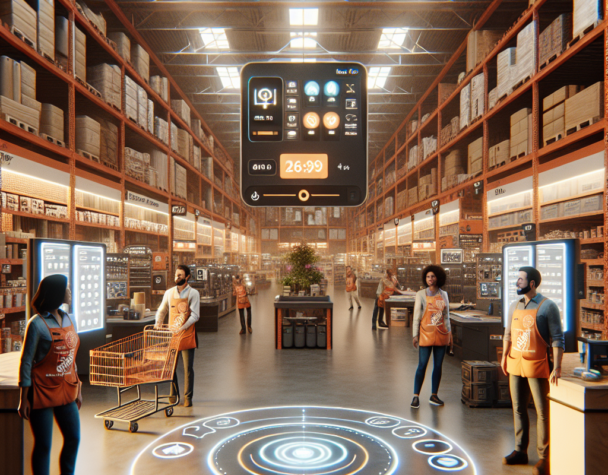
This week Home Depot moved decisively to layer artificial intelligence across customer-facing tools and frontline coaching. Announcements from January highlighted two concrete initiatives: a collaboration with Google Cloud to embed agentic AI across store and Pro workflows, and a separate partnership with Rilla to deliver AI-powered real-time coaching for associates. Together, these programs aim to sharpen the company’s service delivery, speed project fulfillment for professional customers, and lift employee productivity—practical outcomes that investors and operators can track in the months ahead.
Why these AI moves matter for Home Depot
Targeting the Pro customer with practical tools
Google Cloud’s suite focuses on Pro and last-mile logistics: aisle-level navigation, AI-generated materials lists for projects, route intelligence for delivery, and integrated conversational channels (SMS, chat, voice). For contractors and small commercial customers—Home Depot’s higher-margin segment—these features reduce friction around ordering, picking, and delivery. Think of it as converting a multi-step shopping trip into a guided, checklist-driven workflow: faster takeoffs for jobs and fewer costly reorders.
Rilla brings consistent coaching to thousands of associates
The Rilla partnership embeds real-time coaching to standardize sales conversations and service moments across stores. For a retailer with tens of thousands of hourly employees, consistent execution is one of the hardest efficiency levers to pull. AI coaching acts like a backstage conductor—nudging associates at the right moment, reinforcing best practices, and accelerating onboarding for new hires. That can convert into more reliable customer experiences and higher attach rates for add-on products and services.
Operational and investor implications
Efficiency and same-store performance
AI-driven navigation and materials lists help reduce time spent on in-store discovery and curbside pickup errors, which should reduce labor costs per transaction and improve conversion. In an environment where discretionary DIY spending can be uneven, operational gains from technology can help stabilize comparable-store sales by improving throughput and customer satisfaction.
Pro volume and loyalty are near-term catalysts
Contractors prize reliability and speed. Tools that optimize routes and create accurate bill-of-materials lower job risk and scheduling friction. These practical benefits can increase repeat business and wallet share among Pro customers—an area where Home Depot historically has higher margins and stronger retention than many retail peers.
What analysts and the street are saying
Recent analyst action
Following the AI announcements, at least one major analyst firm adjusted its outlook upward, citing confidence in Home Depot’s ability to convert these technology investments into customer and operational gains. While upgrades reflect anticipated benefits, they are not guarantees; investors should monitor adoption metrics and early operational KPIs rather than rely solely on sentiment.
Early signals to watch
Key indicators include adoption rates for the new in-store assistant, changes in Pro order frequency and basket size, reductions in delivery errors, and measurable improvements in associate onboarding speed and associate-customer interaction quality. Quarterly disclosures and pilot program updates will be the clearest evidence that these AI investments are yielding returns.
Conclusion
Home Depot’s recent AI partnerships are concrete, execution-focused initiatives designed to improve the customer journey and enhance associate performance—two levers with direct operational payoffs. By concentrating on the Pro segment, logistics, and frontline coaching, the company is prioritizing measurable efficiency and loyalty gains. For investors and operators, the near-term task is straightforward: track real adoption and outcome metrics to see whether these programs translate into the revenue and margin improvements that analysts are now anticipating.