
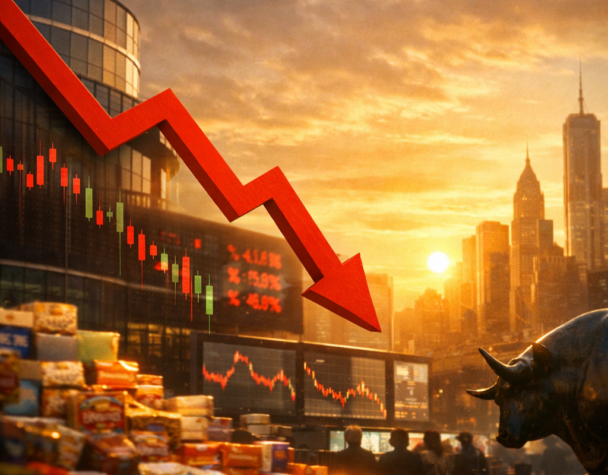
General Mills Guidance Cut Hits GIS, Packs Slide!!
Mon, April 13, 2026General Mills Guidance Cut Hits GIS, Packs Slide!!
Introduction
General Mills (GIS) dominated headlines this week after management cut its fiscal 2026 outlook at the Consumer Analyst Group of New York (CAGNY). The guidance reduction — which includes a projected decline in organic net sales and a sizable drop in adjusted operating profit and EPS — produced an immediate market reaction that rippled across the packaged foods and meats sector. This article summarizes the concrete developments, explains the drivers behind the revision, and outlines what investors should watch next.
What changed at CAGNY: the hard numbers
At its CAGNY presentation, General Mills announced revisions to its fiscal 2026 plan that materially altered near-term expectations:
- Organic net sales forecast revised to a decline in the range of approximately 1.5%–2%.
- Adjusted operating profit and adjusted EPS guidance cut to reflect an expected 16%–20% year-over-year decline.
- Market reaction: GIS shares fell roughly 7% on the announcement, and the S&P 1500 Packaged Foods & Meat Index slid about 3.6%, with 19 of 22 members trading lower.
Concrete headwinds cited
- Tariff and input-cost pressure: Management flagged roughly $200 million of incremental costs in fiscal 2026 tied to new tariff dynamics and related supply-chain impacts.
- Demand shifts: Rapid consumer adoption of GLP‑1 medications appears to be reducing household grocery spend—reports show a measurable decline in purchases of processed carbohydrates and other core categories that affect General Mills’ volumes.
Why this matters for investors
The guidance cut is not merely a forward-looking caution; it reflects identifiable cost and demand forces that compress margins and weaken top-line growth. For investors, the implications are immediate and strategic:
Near-term earnings and valuation pressure
A downward reset of EPS by up to 20% forces reappraisals of valuation multiples, dividend sustainability, and short-term returns. The 7% intraday stock drop shows the market’s sensitivity to tangible earnings risk in a consumer staples name often treated as defensive.
Structural versus cyclical risks
Some headwinds are structural—such as changing eating habits influenced by GLP‑1 drugs—while others are policy-driven and potentially temporary (tariffs). Distinguishing which is which is key for investment horizon decisions:
- If GLP‑1-related consumption shifts persist, General Mills faces a longer runway of volume erosion in categories tied to processed carbs and snacks.
- If tariff costs ease or are mitigated through sourcing changes, some margin pain could be recovered over time.
Company response and strategic levers
General Mills emphasized a portfolio of strategic responses designed to blunt the near-term decline and refocus on profitable growth:
- Product innovation: Management highlighted success from recent launches and expects new products to contribute meaningfully to net sales growth.
- Holistic Margin Management (HMM) targets: Planned cost-savings initiatives aim to deliver roughly 5% in margin improvement.
- Marketing efficiency and digital: The company cited improved customer acquisition economics (lower cost to acquire households) and stronger new-buyer share metrics driven by smarter marketing and digital investments.
Realistic timeline
These actions can stabilize performance but often take quarters to fully materialize. Investors should anticipate continued volatility as management executes restructuring and growth initiatives against an uncertain demand backdrop.
Sector ripple effects
General Mills’ guidance cut had an outsized influence across packaged foods and meats. The S&P 1500 Packaged Foods & Meat Index’s decline reflects the interconnected nature of consumer staples sentiment—when a large, household-name company revises guidance downward, peers often face downward pressure even without company-specific news.
Given overlapping exposures to tariffs, commodity costs, and changing food preferences, other companies in the sector may report similar near-term softness if these forces persist.
Conclusion
General Mills’ decision to lower fiscal 2026 guidance at CAGNY is a concrete, market-moving event driven by a mix of tariff-related costs and evolving consumer behavior linked to GLP‑1 medication adoption. The immediate market reaction was severe, and the sector felt the impact. Management’s focus on innovation, margin improvement, and marketing efficiency offers a path to recovery, but investors should expect a period of execution risk and heightened volatility before fundamentals clearly stabilize.
Key metrics to monitor: subsequent quarterly organic net sales trends, progress on HMM savings, tariff developments, and category-level grocery spending changes among households using GLP‑1 treatments.
End of analysis.