
FSLR: China Export Talks Lift First Solar Stock Up
Mon, April 20, 2026FSLR: China Export Talks Lift First Solar Stock Up
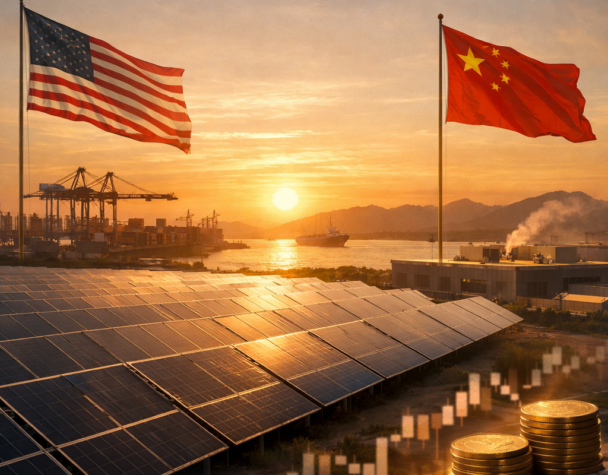
First Solar (FSLR) saw its shares react positively this week after media reported that China is in early-stage discussions about restricting exports of advanced photovoltaic manufacturing technology to the United States. That development, combined with looming Q1 2026 results and shifting U.S. manufacturing dynamics, has focused investor attention on how policy and supply-chain changes may affect the U.S.-based cadmium telluride (CdTe) module maker.
What moved the stock this week
Chinese export-control discussions
Reports indicating China is contemplating limits on exports of advanced PV manufacturing equipment and know-how triggered a roughly 3.5% pre-market lift in FSLR shares on April 15, 2026. The discussions are preliminary and have not become formal policy, but markets interpreted even early-stage talks as a possible strategic shift that could constrain access to the latest crystalline-silicon (c-Si) manufacturing advances for competitors reliant on foreign technology.
Why the development matters for First Solar
First Solar manufactures thin-film CdTe modules primarily in the U.S. and is less dependent on the c-Si supply chain that many global competitors use. Potential export curbs from China could create a relative competitive advantage for domestic producers like FSLR by restricting technology transfer to U.S.-based rivals or complicating their access to high-end equipment. The effect would likely be asymmetric—benefiting producers already integrated in the U.S. while adding friction for those dependent on imported manufacturing inputs.
Industry data and near-term catalysts
Upcoming Q1 2026 earnings
First Solar is scheduled to report first-quarter 2026 results after the close on April 30, 2026, with a company webcast following the release. Given recent uncertainty around policy and supply-chain dynamics, investors will scrutinize management’s commentary on demand, backlog conversion, margin outlook, and expectations for equipment and raw-material availability.
U.S. manufacturing expansion and price trends
Independent reporting this week highlighted a continuing expansion of U.S. PV manufacturing capacity. The number of U.S. solar module manufacturers was noted as increasing from 17 today to around 20 in the near term, though that figure could settle near 18 by 2027 as investment decisions adjust to policy clarity. Solar cell suppliers in the U.S. are projected to grow from five to roughly ten by 2027.
Price movements are already being felt: prices for domestically produced solar cells rose about 4.3% between December and March, while imported modules fell roughly 6.7% over the same window. Modules assembled in the U.S. using foreign cells declined slightly (around 0.4%), reflecting complex dynamics between demand for U.S.-made content and broader pricing pressures.
Implications for investors and First Solar
Potential upside
If export controls materialize, they may create a structural advantage for FSLR due to its U.S.-centric manufacturing and unique CdTe technology. That could translate into stronger contract wins for projects requiring domestic content compliance and a clearer value proposition where supply-chain security is prioritized by developers and utilities.
Risks and counterweights
Even with potential policy tailwinds, heightened domestic competition—new U.S. manufacturers and expanding cell suppliers—can compress prices and margins over time. Additionally, the reported export discussions remain preliminary; markets can quickly reverse if talks stall or policy does not advance. Q1 results and updated guidance will be critical to calibrate near-term expectations.
Conclusion
Recent news this week has placed First Solar at the intersection of policy, supply-chain restructuring, and corporate performance. Preliminary Chinese export-control discussions provided a measurable near-term uplift for FSLR, but the company’s upcoming Q1 2026 report and the trajectory of U.S. manufacturing expansion will determine whether that advantage is sustained. Investors should weigh the potential strategic benefits for a U.S.-based CdTe producer against the evolving competitive and pricing dynamics in domestic PV manufacturing.