
DLR Adds 144MW AI Campus in Batam with BW Digital!
Mon, March 09, 2026DLR Adds 144MW AI Campus in Batam with BW Digital!
Introduction
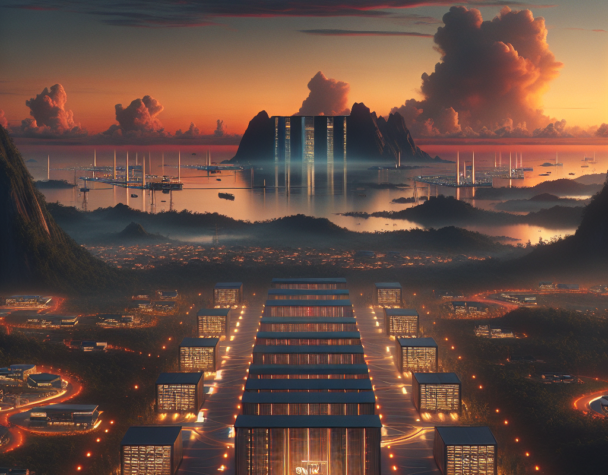
Digital Realty (DLR) announced a strategic collaboration with BW Digital this week to develop an AI-focused data center — NDP-1 — on the SIN12 campus in Batam (the SIJORI corridor). The facility is being designed with 144 MW of electrical capacity, advanced liquid cooling, and direct connectivity to BW Digital’s subsea cable landing station. This is a clear, actionable expansion of DLR’s interconnection footprint in Southeast Asia at a moment when investors are rotating into data-center REITs on the back of AI-driven leasing demand and improved rate expectations.
What the BW Digital Partnership Means for DLR
This deal is more than a land grab. It pairs large-scale power and modern cooling with a subsea cable landing — a combination that directly answers hyperscaler and AI-cohort requirements for latency, bandwidth, and efficient power delivery.
Strategic positioning in a high-growth region
Southeast Asia is becoming an increasingly important staging ground for AI workloads due to proximity to large user bases and regional cloud demand. A 144 MW campus in Batam situates DLR to capture enterprise, cloud, and AI deployments that require both heavy power and low-latency international connectivity. The proximity to subsea infrastructure offered by BW Digital improves the campus’s appeal for customers prioritizing interconnection and cross-border traffic flows.
Reinforcing interconnection-led differentiation
DLR has emphasized interconnection as a competitive advantage; direct subsea access bolsters that stance. Customers seeking multi-region deployment, disaster-resilient routing, and low-latency links to Singapore, Indonesia and beyond gain a compelling option. For DLR, this means the facility is more likely to attract long-term, large-scale leases rather than short-term colocation agreements.
Technical Details and Strategic Advantages
144 MW AI-ready power and advanced cooling
One of the headline specs is the campus’s 144 MW electrical capacity — a scale designed for dense AI clusters and hyperscale builds. Coupled with liquid cooling, which improves thermal efficiency and rack density, the site is tailored for the next wave of high-density GPU racks. That lowers customers’ total cost of ownership and increases the facility’s attractiveness for training and inference workloads.
Subsea connectivity and low-latency routing
Direct access to a subsea cable landing station reduces hops and latency to major regional hubs. For latency-sensitive AI and enterprise applications, this is a technical differentiator that can translate into premium pricing and stickier tenancy—key drivers of predictable cash flow for a REIT like DLR.
Investor Implications
For investors, this announcement is a concrete operational catalyst rather than vague rhetoric. It ties development capital to a clearly defined asset with attributes that match current customer demand.
Near-term catalysts
- Leasing momentum: The facility’s specs and subsea access increase the likelihood of pre-lease activity from hyperscalers or large enterprise customers.
- Valuation support: Data-center REITs have recently attracted investor interest on AI tailwinds and rate optimism. A high-profile, interconnection-rich expansion helps justify multiple expansion or stabilizes forward FFO expectations.
- Geographic diversification: Strengthening presence in Southeast Asia reduces single-region concentration risk and opens new revenue streams.
Risks and watchpoints
- Execution risk: Large-scale builds with advanced cooling and subsea integration have engineering and timetable complexity.
- Capital intensity: Projects of this scale demand significant upfront capital; investor returns depend on disciplined execution and tenant absorption.
- Regulatory and geopolitical factors: Cross-border fiber routes and landing stations can face local regulatory scrutiny or permitting delays.
Conclusion
DLR’s partnership with BW Digital to deliver a 144 MW, AI-ready campus in Batam is a tangible and timely strategic move. It aligns product capability with current enterprise and hyperscale demand by combining high-density power, liquid cooling and direct subsea connectivity. For investors, the announcement is a clear operational catalyst that strengthens DLR’s interconnection value proposition and supports recent positive sentiment around data-center REITs driven by AI infrastructure demand and favorable rate expectations. The key near-term questions are execution speed, leasing progress, and capital discipline — metrics investors should track as the project advances.