
Danaher Buys Masimo: DHR Share Impact Analyzed Now
Mon, March 23, 2026Introduction
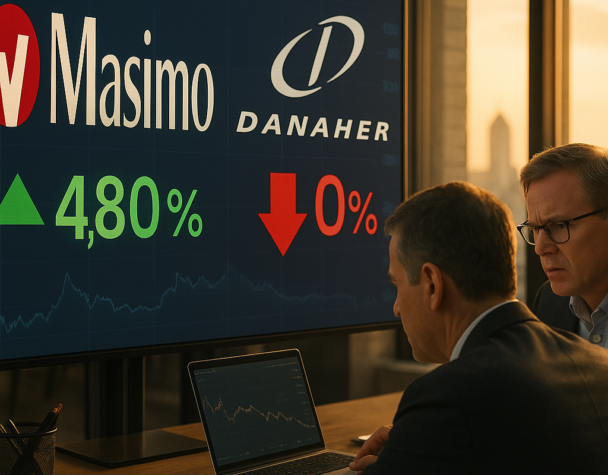
Danaher Corporation’s move to buy Masimo for roughly $9.9 billion at $180 per share has become the week’s most consequential event in diagnostics investing. The offer represents about a 38% premium to Masimo’s prior trading levels and underscores Danaher’s push to strengthen patient-monitoring and diagnostics capabilities. Market response has been mixed: Masimo shares rallied while Danaher’s stock pulled back as investors weighed financing and integration risks. This article summarizes the transaction, the immediate market reaction, and the measurable factors that will matter for shareholders.
Deal Details and Immediate Market Reaction
Terms and strategic rationale
Danaher’s announced purchase of Masimo for approximately $9.9 billion in cash — $180 per share — signals an explicit bet on expanding its diagnostics and patient-monitoring portfolio. Masimo brings established monitoring technologies and a greater foothold in hospital bedside equipment, complementing Danaher’s existing diagnostics and life sciences assets.
Stock moves and analyst context
Following the announcement, Masimo shares jumped on the premium. Danaher shares, however, experienced downward pressure; one notable intraday move showed the stock falling around 5% pre-market to roughly $202.50, reflecting investor concern about near-term leverage and deal execution. Some analysts still see upside for DHR, with consensus price targets materially above current trading, but they emphasize the tradeoff between strategic revenue expansion and potential short-term earnings pressure.
Key Financial and Operational Considerations
Financing and leverage
The all-cash structure raises questions about how Danaher will finance the transaction and what that means for its balance sheet metrics. Investors will closely monitor changes in net debt, interest coverage, and free cash flow after the deal closes. Any meaningful debt issuance or re-direction of cash for the acquisition could affect credit metrics and limit near-term buyback flexibility.
Integration and execution risk
Integration is often the decisive factor in acquisitions of this size. Combining product portfolios, sales channels, and R&D roadmaps takes time and management bandwidth. Success depends on preserving Masimo’s core capabilities while folding in Danaher’s operational rigor. Execution missteps could delay anticipated synergies and weigh on returns.
Capital returns and shareholder signal
Prior to this announcement, Danaher had demonstrated strong capital returns: about $3.09 billion in share repurchases in Q3 2025 and a $2 billion buyback authorization still on the books. Continued dividends and prior repurchases signal management confidence, but the acquisition may re-prioritize capital allocation in the near term. Shareholders will watch whether buybacks continue at prior rates or slow while financing the deal.
Why Diagnostics Matter for Danaher
Revenue mix and strategic fit
Diagnostics already constitute a sizable portion of Danaher’s revenues — historically around the low 40% range — with life sciences and bioprocessing making up the remainder. Adding Masimo strengthens the patient-monitoring side of diagnostics, which can create cross-selling opportunities with existing lab diagnostics and automated testing platforms.
Industry consolidation analogy
Think of Danaher’s approach as filling a gap in a toolkit: it has the precision lab instruments and broad distribution networks; Masimo contributes bedside monitoring tools that extend Danaher’s reach across the continuum of care. If integration proceeds smoothly, the combined offering can be more attractive to hospitals seeking end-to-end diagnostics and monitoring solutions.
Conclusion
The Masimo acquisition is a strategic move that materially reshapes Danaher’s diagnostics footprint. The transaction’s premium lifted Masimo shares immediately, while DHR experienced short-term share weakness driven by financing and integration concerns. Investors should focus on three measurable items in the coming quarters: how the deal is financed (debt vs. cash), management’s integration milestones and synergy realization, and any changes to Danaher’s capital-return program. Those data points will determine whether this acquisition enhances long-term shareholder value or introduces sustained risk to near-term returns.