
Dollar General: Ad Network Boom, Buyback Pause Now
Mon, May 04, 2026Introduction
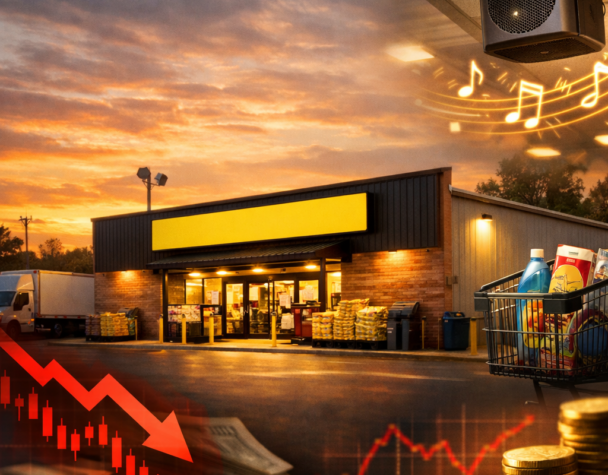
Dollar General (DG) has been the center of investor attention this week after a sustained share-price decline coincided with several concrete strategic moves. The company reported solid underlying sales strength while accelerating a new revenue initiative—an AI-driven in-store audio advertising network—but also signaled a conservative capital-return stance by deferring buybacks. These paired developments are driving near-term volatility for DG in the S&P 500.
What Happened This Week
Seven-Day Slide and Market-Cap Loss
Over the past week DG shares fell sharply, marking a seven-day losing streak that removed roughly $2.4 billion from the company’s market capitalization. That underperformance stood in contrast to a relatively flat S&P 500, indicating company-specific drivers rather than broader market weakness.
Q4 Results: Comps Solid, but Buybacks Deferred
In its latest quarter Dollar General delivered better-than-expected same-store sales (greater than 3.5%), with gains supported by private-label strength and pricing initiatives. Management also cited operational efficiencies—such as SKU rationalization and expanded delivery options—that contributed positively to comparable-store performance.
Despite these operational wins, investors reacted negatively to the company’s capital-allocation update: the planned share-repurchase program was postponed, with buybacks now pushed out beyond the near term. The announcement triggered an immediate stock pullback of more than 6% in early reactions, as buybacks remain a key channel for returning excess cash and supporting EPS in retail names.
Strategic Pivot: DG Media Network and In‑Store Audio Ads
Scaling an AI-Powered Ad Footprint
Dollar General is rapidly expanding its DG Media Network, an AI-enabled in-store audio advertising initiative that turns its dense brick-and-mortar footprint into an ad platform. The rollout now covers approximately 6,000 stores, with plans to double reach toward ~12,000 stores by Q2 2026. The strategy aims to monetize customer dwell time and store traffic, providing a new, recurring revenue stream separate from traditional retail sales.
Revenue Diversification Rationale
For investors, the media network is attractive because it leverages existing real estate and customer reach without proportional increases in inventory carrying costs. If executed at scale, in-store advertising could contribute meaningful margin-accretive revenue over time. Market reaction has been cautiously positive around the initiative, but tangible monetization results and advertiser traction will be key to shifting sentiment decisively.
Why the Stock Is Volatile Now
Balancing Execution Wins with Capital-Return Concerns
The current volatility arises from a clear mix of facts: operational momentum (comp growth, SKU optimization, delivery expansion, and the DG Media Network) versus a conservative near-term capital-return posture. Investors typically reward retailers that both grow sales and return excess cash; deferring buybacks removes one of the immediate levers that supports per-share metrics, prompting revaluation.
Analyst Targets and Short-Term Outlook
Consensus price targets at the time of the pullback suggested modest upside from prevailing levels, implying that much of the long-term growth thesis is already priced in. The next catalysts most likely to change that view are concrete proof points for DG Media Network monetization, visible ad revenue adoption, and any reinstatement or acceleration of buybacks.
Practical Takeaways for Investors
- Monitor DG Media Network metrics: advertiser sign-ups, ad fill rates, and contribution to same-store economics.
- Watch capital-allocation statements: timing and scale of any resumed buyback program will materially influence sentiment.
- Track comparable-store sales and margin trends: persistent comp strength and margin expansion would offset buyback concerns.
- Compare peer moves: other value retailers’ capital returns and advertising pilots can provide context on industry acceptance of in-store media.
Conclusion
Dollar General’s recent share-price decline reflects a classic investor trade-off: operational progress and strategic innovation versus near-term returns to shareholders. The company’s push into AI-driven in-store advertising is a compelling diversification play that could improve long-term returns if it scales, but the deferred buyback policy has introduced short-term downside. Investors should focus on measurable advertising revenue traction and any reversal in capital-return policy when assessing DG’s next leg of performance in the S&P 500.
Keywords: Dollar General, DG, DG Media Network, buyback, in-store advertising, S&P 500