
Deere Rehires, Builds US Plants; Repair Settlement
Mon, May 18, 2026Introduction
Recent company-level developments are giving investors fresh signals about Deere & Company’s (DE) operational trajectory. Over the past week Deere has taken concrete steps that reduce uncertainty and position its manufacturing and distribution footprint for improved resilience. Key items include workforce recalls across U.S. plants, announced facility builds and distribution expansion, and the settlement of a high-profile right-to-repair lawsuit. Together these events clarify near-term production capacity and aftermarket risk—while tariffs continue to loom as a material cost factor.
Operational Momentum: Rehires and Capacity
Workforce recalls reflect rising activity
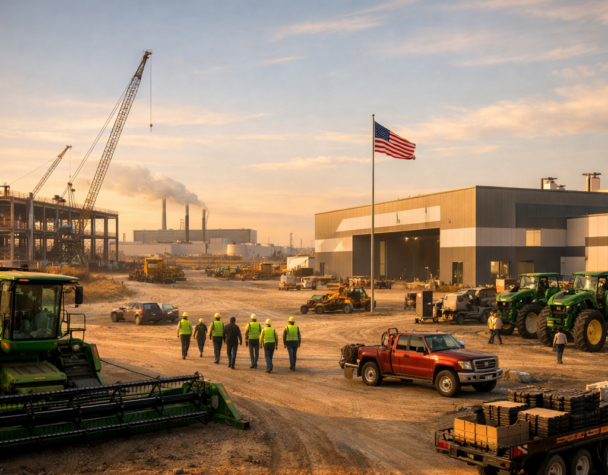
Deere has begun recalling employees to support increased output in construction, forestry and drivetrain production. Reports indicate roughly 50 employees were rehired in April, contributing to a larger trend of more than 300 recalls at key U.S. sites including Dubuque and Davenport in Iowa and Coffeyville, Kansas. For a capital-intensive manufacturer like Deere, rehiring on the factory floor is an early, tangible indicator that order flow and dealer replenishment are recovering.
New U.S. facilities strengthen parts and assembly
As part of Deere’s multi-billion-dollar U.S. investment plan, the company is opening a new excavator plant in Kernersville, North Carolina, and a distribution center in Hebron, Indiana. The excavator facility is reported to involve approximately $70 million in capital and is aimed at improving local production capacity and shortening lead times for construction equipment. The distribution center enhances parts flow and dealer service responsiveness—both critical for reducing downtime for customers and bolstering aftermarket revenue.
Regulatory Clarity: Right-to-Repair Settlement
$99 million settlement reduces aftermarket uncertainty
Deere agreed to a roughly $99 million class-action settlement concerning its repair software and diagnostic access. Under the settlement terms, independent repair providers and customers will have access to necessary repair tools and software for at least ten years. While Deere did not admit wrongdoing, the agreement removes a regulatory and reputational cloud that had raised concerns about future liability and restrictions on independent service channels.
Why this matters to investors
Aftermarket service and parts are a steady, higher-margin revenue stream for agricultural and construction OEMs. The settlement preserves independent repair channels and dealer trust, which helps sustain parts sales and service volumes. For shareholders, this translates into reduced legal risk and a clearer view of sustainable aftermarket margins going forward.
Cost Headwinds: Tariffs and Margin Pressure
Despite encouraging operational signs, Deere faces a meaningful near-term headwind from tariffs. Management estimates an approximate $1.2 billion pre-tax tariff impact in fiscal 2026—roughly double the previous year’s tariff exposure. This pressure is concentrated in larger equipment categories and can compress margins if offsetting price or cost actions are insufficient. Investors should weigh the interplay between improving volume trends and persistent input-cost risks when assessing DE stock.
Putting the Pieces Together for DE Stock
Recent developments tighten the information set for investors. Rehiring and new U.S. facilities point to recovery in equipment demand and improved supply-chain resilience. The right-to-repair settlement eliminates a notable legal overhang and supports aftermarket stability. Conversely, tariffs remain a quantifiable drag on profitability. Taken together, the net effect for Deere is greater clarity: operating momentum and structural investment that can support mid- to long-term growth, counterbalanced by short-term margin pressures that merit close monitoring.
Conclusion
Deere’s recent operational moves and legal resolution give market participants concrete signals to evaluate DE stock. The combination of factory rehiring, strategic U.S. plant and distribution investments, and the $99 million right-to-repair settlement reduces uncertainty around production capacity and aftermarket access. However, an estimated $1.2 billion tariff hit in fiscal 2026 remains a clear near-term headwind. For investors, the decision hinges on anticipated demand durability and Deere’s ability to offset tariff-driven margin pressure through productivity, pricing or cost discipline.