
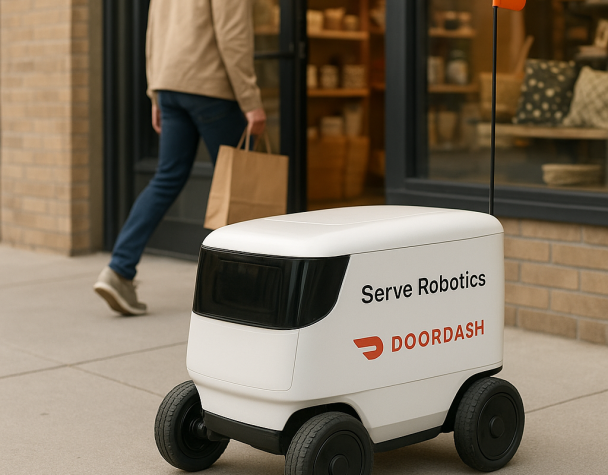
Serve Robotics Expands Autonomous Delivery Reach with DoorDash Amid Growing Retail Push
Sun, August 30, 2026In a key development affecting DoorDash (NASDAQ: DASH) and its positioning in the autonomous delivery and retail segments, Serve Robotics announced this week an expansion of its delivery robot service in partnership with DoorDash to include Washington, D.C., and San Jose, California. This move increases Serve’s coverage in key urban centers—on top of existing service in Chicago, Los Angeles, and Miami—and strengthens DoorDash’s capacity for innovative last‑mile delivery options in dense markets. This announcement was made by Serve Robotics on August 17, 2026 and confirmed via Bloomberg reporting. The announcement follows Serve’s recently disclosed decision not to renew its contract with Uber beyond early 2027.
Serve Robotics’ expansion comes alongside the introduction of “Beacon,” a new modem-enabled device provided at no cost to restaurants. Beacon signals robot arrivals directly to restaurant staff, reducing reliance on fragmented third‑party systems and streamlining robotic delivery pick‑ups. Serve also revealed plans to deploy micro depots in high‑demand neighborhoods—starting with Miami—to house, charge, and dispatch robots closer to popular eateries, enabling faster fulfillment.
This push into autonomous delivery aligns well with DoorDash’s broader strategic pivot toward diversifying services. Earlier this week, DoorDash announced a major expansion of its retail marketplace, adding Barnes & Noble, Carter’s, Kohl’s, and Gap/Gap Factory ahead of the back‑to‑school shopping season. These new partnerships bring over half a million products across books, kids’ apparel, household items, and apparel into its on‑demand delivery network, with orders eligible for delivery in under an hour. The rollout marked DoorDash’s largest venture yet into department store and retail verticals.
Together, these developments underscore DoorDash’s two‑pronged approach to growth: expanding delivery modalities through autonomous robotics while simultaneously broadening product selection across retail categories. Autonomous delivery innovations like those from Serve Robotics may enhance efficiency and cost dynamics, especially in densely populated urban zones. At the same time, the retail expansion accelerates DoorDash’s evolution from a food‑centric platform into a broader local commerce ecosystem—particularly as families ramp up spending during back‑to‑school season.
Investors tracking DASH stock should monitor how these strategic moves may influence unit economics, delivery margins, and customer engagement over time. While no immediate market reaction or stock movement has been explicitly tied to these announcements, together they point to an evolving DoorDash business model that blends technological innovation with retail diversification—key trends that could shape its competitive positioning.