
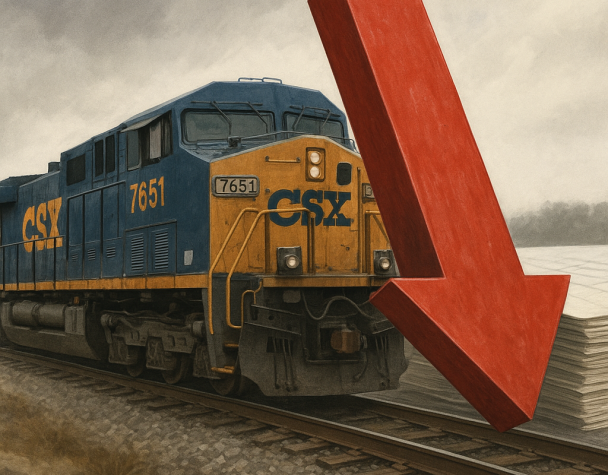
CSX Sees Operational Deterioration in Latest STB Report Amid Stable Earnings Momentum
Thu, August 27, 2026CSX Corporation (NASDAQ: CSX) encountered harder operating conditions in the most recent Surface Transportation Board (STB) data for the week ending August 19, 2026, as the railroad’s average train speed slipped and terminal dwell climbed modestly. Meanwhile, the company’s robust second-quarter performance earlier in the summer remains a key point of investor focus.
Operational Challenges Highlighted by STB Data
The STB’s weekly freight service metrics for the period ending August 19 show that CSX’s system average train speed declined to 23.1 mph, down from 23.9 mph the prior week. Intermodal speeds eased to 28.8 mph from 29.6 mph, and grain unit train speeds dropped to 21.3 mph from 22.2 mph. On the positive side, crude oil unit train speeds improved notably to 29.9 mph, up from 26.2 mph. During the same week, terminal dwell — the average time cars spend in terminals — rose slightly to 21.38 hours from 21.03 hours the previous week.
These figures suggest a slight deterioration in network fluidity, which may reflect capacity constraints, congestion, or underlying inefficiencies in the short term.
By comparison, other Class I railroads posted mixed results. BNSF saw its system speed dip to 24.4 mph, while Union Pacific maintained a steadier pace. Across the board, CSX’s performance sits in the moderate range among its peers, reflecting operational headwinds but no systemic breakdown.
Context from Recent Earnings Strong Performance
Just weeks earlier, on July 22, CSX released strong second-quarter results for 2026. The company delivered record quarterly revenue of $3.94 billion and $1.00 billion in net earnings, translating to $0.54 diluted EPS. All key metrics improved year-over-year—revenue rose 10%, operating income jumped 17%, and EPS increased 23%. The company also reported a 6% increase in total carload and intermodal volume. CSX cited improved execution, disciplined management, and broad-based growth across its merchandise, intermodal, and coal segments.
Additionally, CSX raised its full-year guidance: it now expects mid- to high-single-digit revenue growth, more than 350 basis points of operating margin expansion, and over 80% growth in free cash flow. Operational gains such as a 19% improvement in FRA injury rate and a 30% drop in train accidents were also emphasized.
Bridging Short-Term Pressures and Long-Term Momentum
The operational softness revealed in the late‑August STB data does not undermine CSX’s solid financial footing, but it highlights the lag between the company’s strategic execution and service performance. Sluggish train speeds and rising terminal dwell may indicate localized congestion or execution gaps that, if prolonged, could impact customer satisfaction and efficiency.
Investors and analysts are likely to monitor whether these service metrics rebound in the coming weeks. Improvement would reinforce confidence in CSX’s operational resilience amid strong financial results and upwardly revised guidance.
Looking Ahead
CSX’s next earnings release, expected in mid‑October, will be a critical data point. Should service metrics show recovery alongside continued financial momentum, the company could reinforce its position as a top-performing Class I operator. However, sustained operational lags may raise concern about network strain or execution limitations.
In the near term, market watchers should watch for updates on service benchmarks from the STB, investor commentary during quarterly calls, and any regional service alerts from CSX indicating network stress or improvement.
CSX stock closed at $51.76 on August 26, reflecting a 0.83% gain. That rise may reflect lingering confidence in the company’s earnings trajectory, though the operational report serves as a reminder that execution risks remain.