
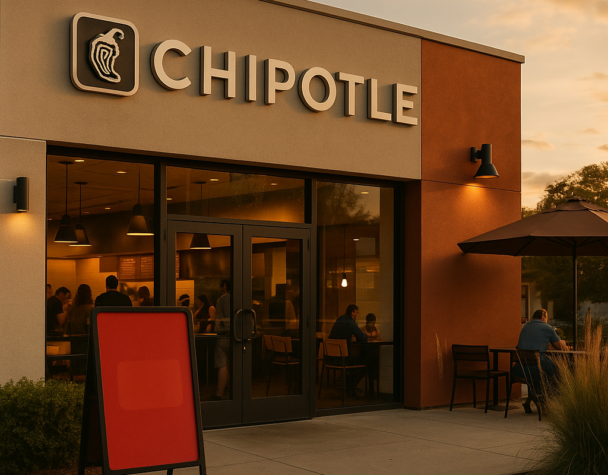
Chipotle's Turnaround: Value Tests and Menu Bets
Mon, March 23, 2026Chipotle’s Turnaround: Value Tests and Menu Bets
Recent analyst commentary and industry reports have repositioned Chipotle Mexican Grill (CMG) at the center of a fast-casual debate: can menu innovation plus targeted value promotions counteract softening traffic driven by elevated prices? In the past week, bullish notes from major brokerage houses, a sector outlook from Consumer Edge, and a widely-shared report about a pilot “Happier Hour” promotion have combined to shape a clearer — and more actionable — narrative for investors watching CMG inside the S&P 500.
What changed this week
Analysts highlight tangible catalysts
Oppenheimer and Deutsche Bank recently elevated Chipotle in their restaurant coverage, pointing to concrete sales drivers: new limited-time offers, an expanded assortment of sauces and high-protein options, and smaller, lower-priced items designed to broaden appeal. The thrust of these notes is pragmatic: investors should be watching execution of specific items and promotions rather than abstract brand strength. For CMG — a large-cap S&P 500 name with high visibility — successful product rollouts can translate into outsized sentiment shifts among institutional holders.
Industry research stresses value fatigue
Consumer Edge’s 2026 Restaurant Outlook provided a counterpoint, arguing that several fast-casual operators are confronting demand headwinds as menu prices remain elevated. The report flags that brands which fail to project clear value are seeing traffic stall, whereas chains that emphasize affordability or superior digital engagement are holding or growing share. For Chipotle, the implication is direct: product novelty alone may not be enough if customers perceive the overall offering as too expensive.
‘Happier Hour’ pilot: signal or rumor?
What the reported pilot means
Social posts and thread summaries circulating this week describe a company pilot of a time-limited value program dubbed “Happier Hour.” If the program is real and scaled, it would mark a tactical shift for a brand that has historically leaned into premium pricing and quality messaging. In practical terms, a Happier Hour could be used to:
- Drive incremental visits during traditionally slow dayparts (afternoon and early evening).
- Lower the effective price point for price-sensitive core customers without a permanent menu price change.
- Generate trial for new smaller-portion or lower-cost items highlighted by analysts.
Investors should treat initial social reports as a signal to monitor company communications, same-store sales trends, and any pilot performance metrics (traffic lifts, average checks, redemption rates) that Chipotle may disclose.
Consumer shifts and why they matter to CMG
On-the-ground commentary from consumers suggests middle-income diners — historically a key segment for Chipotle — are trimming discretionary visits. That dynamic raises two structural risks: first, sustained traffic erosion can force a trade-off between margin-protecting price increases and traffic-driving value offers; second, frequent menu or portion changes risk eroding trust if customers feel the brand is inconsistent.
Balancing value and brand equity
The core challenge for Chipotle is balancing short-term traffic initiatives with long-term brand positioning. Analogous to a sports team adding a new role player midseason, a well-timed value pilot can change outcomes without rewriting the team’s identity — but overuse can dilute the brand. For investors, the watch items are the cadence and permanence of promotions, plus whether new lower-priced menu items maintain Chipotle’s quality perception.
Investment implications for CMG in the S&P 500
From an equity perspective, the combination of analyst optimism and actionable pilot testing is constructive: it reduces uncertainty by supplying clear, testable catalysts. Positive pilot results could accelerate multiple expansion as revenue momentum returns. Conversely, disappointing traffic or margin contraction tied to heavy discounting would justify a more cautious stance.
Practical indicators investors should monitor over coming quarters include same-store sales growth, traffic vs. ticket decomposition, promotional cadence and duration, and management commentary on margin versus market-share priorities.
Conclusion
This week’s developments — analyst praise for menu-driven catalysts, a warning from Consumer Edge on price sensitivity, and reports of a value-focused pilot — together create a sharper investment story for Chipotle. The company appears to be testing the boundary between premium positioning and pragmatic value tactics. For holders and prospective investors in CMG, the near-term outlook will be shaped less by abstract optimism and more by measurable outcomes: traffic lifts from promotions, performance of new menu items, and whether pricing strategy can be adjusted without eroding brand equity.