
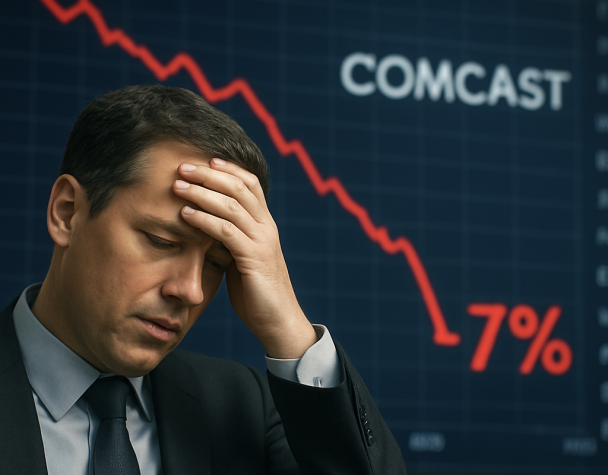
Comcast Shares Slide Near 7% After CFO Warns Broadband Subscriber Losses to Worsen This Quarter
Fri, September 11, 2026Comcast (NASDAQ: CMCSA) shares plunged nearly 7% during Wednesday’s trading session following cautionary remarks from Chief Financial Officer Jason Armstrong at the Goldman Sachs Communacopia & Technology Conference. Armstrong warned that broadband subscriber losses are not expected to improve in the third quarter, signaling deepening challenges in the company’s core connectivity business.
In his comments, Armstrong highlighted the growing competitive pressure from rivals offering gigabit-speed internet at very low prices—sometimes between $30 and $40 per month—calling those levels “not a rational price point” for long-term investment in infrastructure. This aggressive pricing environment has made it increasingly difficult for Comcast to retain customers or justify network investments at its current pricing around $50 per month for comparable plans. Shares fell as much as 7%, marking their worst single-day drop since July. Charter Communications also slipped, underscoring broader sector weakness. As of the close, CMCSA is trading at $25.17—a 2.32% increase on the day prior to the sell-off.
Armstrong made clear that while Comcast anticipates some full-year improvement in broadband trends, the near-term outlook remains challenged. He cautioned that subscriber attrition in Q3 could exceed last year’s levels, with consensus expecting around 89,000 net residential broadband losses versus 91,000 in Q3 2025; however, some analysts, including KeyBanc, forecast subscriber losses as steep as 125,000. This erosion may lead to reductions in Average Revenue Per User (ARPU) as Comcast attempts to retain its customer base amid intense pricing wars.
Competitive Pricing Pressure Intensifies
Broadband competition has escalated dramatically: Optimum markets a gigabit fiber plan in New York for just $25 per month, Verizon offers base Fios packages starting at $30 (though gigabit tiers go up to $80), while Charter’s Spectrum has promotional gigabit pricing near $60 for the first year. Such offers magnify pressure on Comcast’s profitability, especially given its higher base price. Armstrong stressed that these ultralow price points suppress the return on investment for network upgrades, and the company must navigate this pricing environment carefully as it pivots strategy post-spinoff.
Broadband Woes Compound Other Unit Headwinds
Armstrong didn’t stop at broadband concerns; he also flagged continued softness in the Orlando theme park market. Elevated fuel prices and high airfare are dampening attendance, prolonging the headwinds reported in Q2. That quarter, Comcast reported a net loss of 181,000 broadband customers, even as ARPU grew modestly by around 1.1%, supported by pricing simplification and promotional initiatives. However, these measures also exerted pressure on profitability amid elevated marketing and customer service costs.
Strategic Implications for Comcast and Investors
This hawkish commentary arrives at a pivotal moment for Comcast. With plans already in place to spin off its media assets—including NBCUniversal and Sky—into a separate public company, the connectivity division will soon stand on its own as the primary value driver of the parent entity. Subscriber losses and pricing challenges in this business could consequently shape investor sentiment and valuation metrics as the spin is executed.
Moving forward, investors will closely monitor whether Comcast’s cost-transformation initiatives—aimed at preserving liquidity ahead of the separation—can offset continued broadband erosion, and whether pricing and bundling strategies can achieve sustainable retention and margin expansion.
In summary, while Comcast remains a high cash-generating enterprise, its connectivity arm faces near-term turbulence. The company’s ability to stabilize broadband subscriber trends and navigate aggressive pricing will be critical to maintaining investor confidence as it transitions through corporate restructuring.