
Carrier Sells Fire Units, Data-Center Orders Surge
Mon, May 04, 2026Carrier Sells Fire Units, Data-Center Orders Surge
Carrier Global Holdings (NYSE: CARR) moved decisively this week to reshape its business: the company closed a $3 billion sale of its commercial and residential fire assets and reported first-quarter results that combined strong commercial demand—especially for data-center cooling—with notable margin pressure and soft residential demand. These concrete developments alter Carrier’s capital allocation and near-term earnings outlook while sharpening the company’s focus on high-capacity HVAC and refrigeration solutions.
Main developments
1. $3 billion divestiture of fire assets
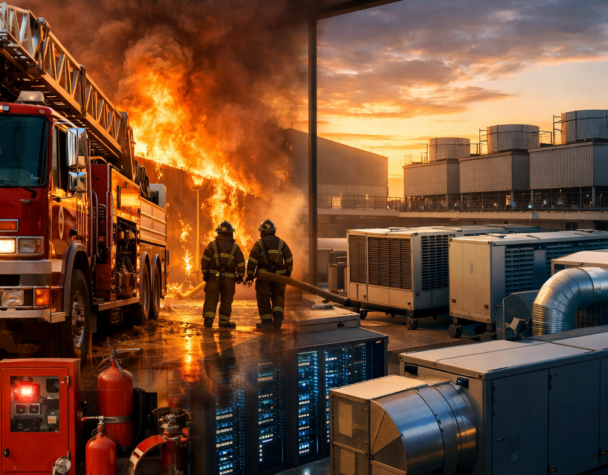
Carrier completed the sale of its commercial and residential fire division to a Lone Star Funds affiliate for $3 billion. Management framed the transaction as part of a broader portfolio optimization designed to concentrate resources on the firm’s core commercial HVAC, refrigeration, and data-center businesses. The sale strengthens liquidity and provides capital that can be used for R&D, targeted investments, or shareholder returns.
2. Q1 results: topline beat, margins under stress
Carrier reported Q1 revenue of $5.34 billion and adjusted earnings per share of $0.57, exceeding analyst expectations. On a GAAP basis, EPS was $0.28. Free cash flow was modestly negative—approximately negative $15 million—reflecting timing and working-capital dynamics. While revenue and adjusted EPS beat estimates, the company disclosed margin compression driven by higher input costs and softness in residential HVAC demand, particularly in certain regions including China.
3. Data-center demand accelerates
The standout metric was a surge in data-center HVAC orders—reported as an increase of roughly 500%—which has built a backlog that management says covers its $1.5 billion data-center target for 2026. Product cadence for the data-center line was reiterated: 1 MW cold distribution units (CDUs) are already in the field, 3 MW variants are expected in the third quarter, and 5 MW systems are planned for late 2026 or early 2027. Carrier also noted expanded collaboration on two-phase cooling technologies with partners such as ZutaCore.
Implications for CARR stock and investors
Balance-sheet and strategic focus
The $3 billion divestiture reduces exposure to lower-growth fire segments and bolsters liquidity. By recycling proceeds into the higher-growth commercial and data-center portfolio, Carrier is signaling a strategic tilt toward areas with longer multi-year secular demand and higher innovation barriers.
Near-term earnings and margin considerations
Despite the revenue beat, investors must weigh margin pressures. Elevated costs and weak short-cycle residential demand could keep full-year margins under pressure unless pricing actions or cost reductions materialize. Analysts and active investors will watch upcoming quarterly updates for signs of margin stabilization and clearer free-cash-flow improvement.
Execution risk vs. growth opportunity
The order surge in data-center cooling provides tangible backlog visibility and a clear growth vector. However, execution—delivering product scale, managing supply-chain costs, and converting backlog to cash—will determine whether that growth translates into sustainable earnings and stock appreciation.
Operational highlights and product roadmap
Carrier is advancing a multi-tier CDU strategy (1 MW, 3 MW, 5 MW) that targets hyperscale and enterprise data centers. The 1 MW offering is available now, 3 MW units are slated for Q3, and higher-capacity 5 MW systems are planned for late 2026/early 2027. Two-phase cooling collaborations aim to improve energy efficiency and density—features attractive to data-center operators seeking lower total cost of ownership.
Conclusion
This week’s developments make Carrier a more focused business: the $3 billion fire-asset sale and an outsized increase in data-center orders materially change the company’s mix of revenue and capital deployment. The positive demand signal in commercial and data-center cooling is counterbalanced by margin headwinds and residential softness. For shareholders, the coming quarters should clarify whether Carrier can convert its strong backlog into margin recovery and consistent free cash flow, which will be central to the stock’s next phase of performance.