
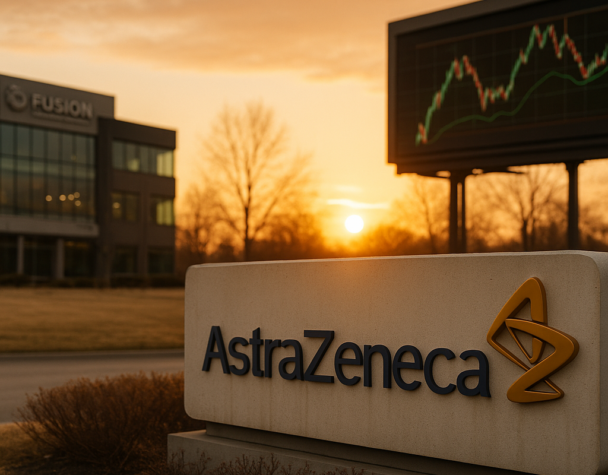
AstraZeneca's Bold Move: Fusion Buy & Nasdaq Exit.
Thu, March 19, 2026AstraZeneca Sharpening Oncology Focus After Fusion Deal and Nasdaq Exit
In a compact week of high‑impact corporate moves, AstraZeneca (AZN) completed a set of developments that recalibrate investor attention: a definitive agreement to acquire Fusion Pharmaceuticals for roughly $2.4 billion, formal removal from the NASDAQ‑100 index, and the release of Q4 2025 results that underscore continuing revenue strength—particularly in oncology. These concrete events tighten the investment thesis around AZN: disciplined M&A to refill the pipeline, steady cash generation, and evolving index exposure that can influence passive flows.
Key Corporate Moves
Fusion Pharmaceuticals acquisition: deal details and strategic fit
AstraZeneca agreed to buy Fusion Pharmaceuticals in a cash transaction priced at about $21 per share, plus up to $3 per share in contingent regulatory milestone payments—bringing the deal value to roughly $2.4 billion. Fusion’s lead programs focus on next‑generation radioconjugates, including candidates intended to deliver targeted radiotherapy to difficult‑to‑treat tumors. For AZN, the acquisition accelerates exposure to radiopharmaceuticals, a high‑value, high‑growth corner of oncology that complements established franchises such as Tagrisso and Imfinzi.
NASDAQ‑100 removal: timing and investor implications
AstraZeneca was removed from the NASDAQ‑100 and replaced by Walmart, an index reconstitution that took effect in mid‑January. While AZN remains widely listed and traded, exclusion from a major U.S. tech‑heavy index can trigger short‑term rebalancing by exchange‑traded funds and institutional strategies that track the index. Over time, however, fundamentals—drug sales, pipeline progress, and capital returns—will drive valuation more than index membership.
Financial Performance and Guidance
Q4 2025 highlights
AstraZeneca reported Q4 2025 revenue of about $15.5 billion, with the oncology franchise contributing roughly $7.03 billion—driven by solid performances from Tagrisso and Imfinzi. Management noted increased EPS and raised the dividend to $3.30 per share, reflecting confidence in cash flow generation and the company’s ability to fund both organic R&D and strategic acquisitions.
Guidance and capital allocation
Management reaffirmed an ambitious long‑term revenue target near $80 billion by 2030, and outlined mid‑ to high single‑digit revenue growth with low double‑digit EPS expansion for the year ahead. Capital expenditure plans are being stepped up to support manufacturing and geographic expansion, while dividends and targeted M&A remain core uses of free cash flow.
Investor Takeaways
Oncology pipeline: diversification and upside
The Fusion deal strengthens AZN’s radioconjugate capabilities—an area with growing clinical interest and premium pricing potential if late‑stage data confirm safety and efficacy. For investors focused on growth drivers, the acquisition is a concrete, near‑term addition to the company’s oncology playbook rather than speculative pipeline chatter.
Index dynamics and share liquidity
Removal from the NASDAQ‑100 can prompt temporary outflows as index funds rebalance, but AZN’s broad global float and listing status sustain deep liquidity. Long‑term holders should weigh transient indexing effects against the company’s cash generation and strategic acquisitions that target durable revenue streams.
Conclusion
AstraZeneca’s purchase of Fusion Pharmaceuticals and its NASDAQ‑100 exit are clear, measurable events with immediate strategic and investor ramifications. The acquisition deepens AZN’s oncology pipeline in a high‑potential modality, while Q4 results and raised dividends signal robust cash flow and management confidence. Investors evaluating AZN should focus on integration risk and upcoming clinical readouts for radioconjugates, while treating index reconstitution as a short‑term technical factor rather than a fundamental shift.