
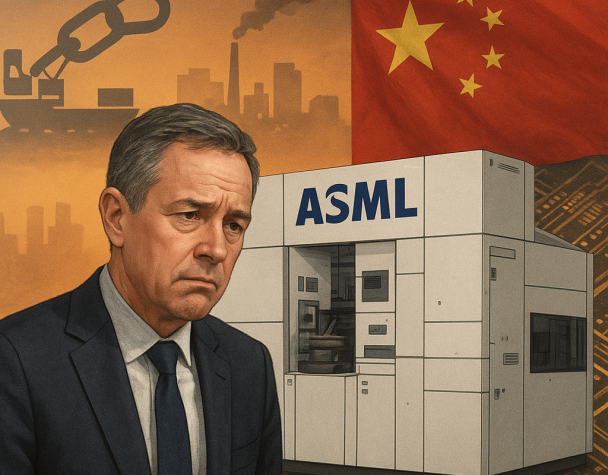
ASML Faces Challenges Amid China's Semiconductor Advances and Supply Chain Constraints
Fri, July 31, 2026ASML Faces Challenges Amid China’s Semiconductor Advances and Supply Chain Constraints
ASML Holding NV, a leading supplier of semiconductor manufacturing equipment, is navigating a complex landscape marked by China’s strides in domestic chipmaking and ongoing supply chain limitations.
China’s Progress in Domestic Lithography Machines
A state-backed Chinese company in Shanghai has commenced mass production of domestic immersion deep ultraviolet (DUV) lithography machines, a significant development in China’s semiconductor industry. The first units are slated for delivery in 2026 to major Chinese semiconductor firms, including SMIC, Hua Hong, and CXMT. While these machines currently lag behind ASML’s offerings in performance and reliability, they represent a strategic move towards reducing dependence on foreign technology. This advancement comes amid U.S. legislative efforts to restrict Chinese access to advanced semiconductor equipment, potentially impacting ASML’s market share.
Supply Chain Constraints Impacting ASML’s Production
Zeiss Semiconductor Manufacturing Technology (SMT), the exclusive supplier of high-precision optical components for ASML’s lithography scanners, is expanding its production capabilities at its Oberkochen site in Germany. This expansion aims to address a significant bottleneck in the global semiconductor supply chain, as Zeiss’s facilities are the only ones globally capable of producing these complex optical columns. ASML’s ability to scale production is heavily dependent on Zeiss’s capacity, with the company projecting a 30% increase in Low-NA EUV scanner output by 2027. In 2025, ASML’s purchases from Zeiss rose to €4.41 billion, underscoring the critical nature of this partnership.
Market Performance and Industry Outlook
As of July 31, 2026, ASML’s stock is trading at $1,651.44, reflecting a 0.39% increase from the previous close. The global semiconductor equipment market continues to grow, with worldwide sales reaching $135.1 billion in 2025, a 15% increase from 2024. This growth is driven by investments in advanced logic, memory, and AI-related capacity expansion.
Conclusion
ASML is at a pivotal juncture, contending with China’s advancements in domestic semiconductor manufacturing and addressing supply chain constraints through strategic partnerships. The company’s ability to navigate these challenges will be crucial in maintaining its leadership in the semiconductor equipment industry.