
ASML: China Rival Emerges as TSMC Raises Capex Now
Thu, March 19, 2026Introduction
ASML — the Dutch maker of the world’s most advanced lithography machines — sits at the intersection of a rapid AI-driven spending cycle and growing geopolitical friction. In the past week several tangible developments have moved the needle for ASML shareholders: a public call from Chinese chipmakers to build a domestic alternative, reinforced demand signals from TSMC’s elevated capital expenditure plans, and the company’s own strong 2025 results and guidance. This article distills those facts, explains how they affect ASML’s near-term outlook and stock dynamics in the Nasdaq‑100, and outlines what investors should watch next.
What happened this week
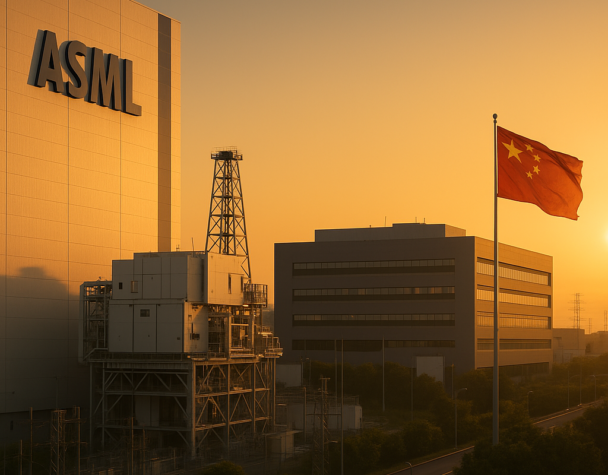
China’s coordinated push to develop a domestic ASML
On March 6, 2026, senior executives from leading Chinese semiconductor firms made a public appeal to accelerate a domestic effort to create lithography technology comparable to ASML’s systems. Reporting in the last week also highlighted an incident where a Chinese firm sought technical help after failing to successfully reassemble a DUV lithography tool following an internal teardown. These are concrete signals of rising state‑backed ambition and growing technical attempts to localize advanced equipment.
TSMC’s elevated capex keeps equipment demand robust
TSMC’s updated guidance for 2026 capital expenditure—recently raised to around $52–$56 billion—continues to underpin demand expectations for suppliers of advanced process equipment. The announcement has been a catalyst for semiconductor-equipment names, including ASML, and was associated with perceptible moves in ASML shares as investors reprice the near‑term order pipeline tied to AI and advanced-node wafer capacity demand.
ASML’s 2025 performance and 2026 outlook
ASML reported record full‑year 2025 results, with reported net sales and net income showing significant strength. Management reiterated that demand, particularly for EUV systems used in advanced logic and AI chips, remains healthy and provided a firm outlook for continued growth into 2026. Those results anchor the positive valuation narrative even as external risks increase.
Why these developments matter for ASML stock
Demand tailwinds vs. geopolitical headwinds
There are two primary, concrete forces acting on ASML’s valuation:
- Demand tailwinds: Elevated capex plans from leading foundries (notably TSMC) translate directly into stronger near‑term bookings for lithography tools. EUV systems in particular are highly constrained and central to advanced-node capacity expansion—supporting ASML’s revenue visibility and justifying premium multiples.
- Geopolitical and competitive headwinds: A coordinated push in China to develop domestic lithography capability is a measurable risk. Building complex EUV-class systems requires extensive supply chains, specialized components, and years of R&D; nonetheless, sustained state support and incremental reverse‑engineering progress can reduce ASML’s addressable market in the longer term. Recent reports about failed DUV reassemblies demonstrate the technical difficulty but also that efforts are ongoing.
Financial resilience buffers short-term shocks
ASML’s robust 2025 results give the company financial flexibility to manage near-term disruptions—through continued R&D, supply-chain resilience measures, and contractual protections. That financial strength is why investors have continued to assign a premium to ASML within the Nasdaq‑100, even as geopolitical concerns grow.
Practical investor considerations
Monitor concrete leading indicators
Investors focused on ASML should watch a short list of tangible signals rather than vague narratives:
- Order backlog and shipment cadence in ASML earnings and trading updates (EUV vs DUV mix).
- Capex guidance and actual spend by major customers (TSMC, Samsung, Intel), which drive machine demand timing.
- Clear policy actions or export‑control changes from the U.S., EU, or the Netherlands that alter ASML’s ability to sell to specific markets.
- Documented progress by Chinese firms—technical milestones, component sourcing breakthroughs, or successful tool assembly—rather than rhetoric alone.
Scenario framing for position sizing
Prudent scenarios for investors include: a base case where AI-driven capex sustains demand for several years and ASML keeps a technology lead; a downside where incremental access losses to large customers (e.g., China) materially cut long‑term revenue growth; and a mid case where ASML retains premium pricing but faces slower share gains in certain regions. Position sizing should reflect which scenario an investor judges most likely and how much geopolitical risk premium they want in their portfolio.
Conclusion
The latest week delivered concrete developments that matter for ASML: a publicized Chinese initiative to create domestic lithography alternatives, continued demand affirmation from TSMC’s raised capex plan, and ASML’s own strong financials. Short‑term upside is still being driven by AI‑related wafer fab investments, while the longer-term risk of substitution or restricted market access in China is a measurable factor investors must incorporate. Following specific, verifiable indicators—order flow, customer capex, and documented technical progress by competitors—will give the clearest signal for adjusting exposure to ASML within the Nasdaq‑100.
Data points referenced: recent public statements from Chinese semiconductor executives (early March 2026), TSMC’s 2026 capex guidance (~$52–$56B), and ASML’s record 2025 financials and 2026 outlook as reported in company updates.