
ASML Advances High‑NA EUV Deployment with Fleet Expansion and New Campus Groundbreaking
Tue, October 06, 2026ASML this week marked a material advance in its High‑NA EUV lithography rollout, confirming that 10 systems are now operational across four major chipmakers globally, with three more in shipment or installation. The company targets 90% fleet availability by the fourth quarter of 2026 — a critical threshold for high-volume manufacturing deployment.
The update was disclosed by ASML Senior Vice President Greet Storms during SEMICON Taiwan, underscoring growing customer adoption of the next‑generation machines priced between $380 million and $400 million each. The ramp-up is anchored by commitments from Intel, TSMC, Samsung and SK Hynix — a significant signal of confidence in High‑NA EUV amid booming AI chip demand.
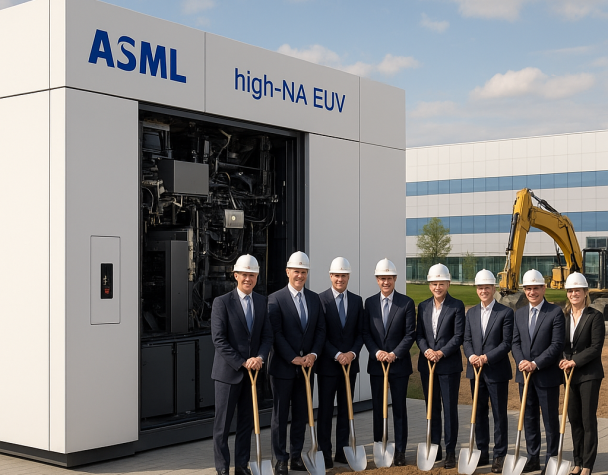
Concurrently, ASML broke ground on a new industrial campus in Eindhoven. The campus, ultimately planned to house up to 20,000 workers, will include offices, logistics infrastructure and manufacturing facilities — a sizeable expansion to support its growing lithography tool output.
Why This Matters for ASML and Investors
High‑NA EUV represents the most advanced lithography technology available, enabling finer chip patterning essential for next‑generation AI and high‑performance logic. The fleet expansion signals that ASML is progressing beyond development and into volume deployment. Reaching 90% availability by year-end would further attract chipmakers racing to scale AI‑centric fabrication.
The Eindhoven campus expansion directly supports this push by boosting ASML’s production and logistical capacity, crucial given the complexity and size of EUV systems. The dual momentum — technical deployment and infrastructure scaling — strengthens ASML’s competitive position amid elevated global demand for cutting‑edge chipmaking tools.
Looking Ahead
ASML aims for 90% fleet utilization by Q4 2026, which would represent a significant milestone toward mass High‑NA integration. Watch for updates on shipments, installations and availability metrics in upcoming investor disclosures.
On the infrastructure front, progress in construction, hiring at the new campus and facility commissioning will be key indicators of ASML’s capacity to meet growing customer demand.
The evolution of High‑NA EUV adoption also merits close attention; if key players like TSMC and Samsung begin deploying volume logic or memory products using these tools, it would signal a major inflection point for the semiconductor equipment market.
Overall, combining fleet ramp-up with expanded production capacity positions ASML to capitalize on rising demand from AI, high-performance computing and advanced logic segments.