
AMD Gains: Vultr $1B Instinct Win HPE Backs Helios
Thu, December 04, 2025AMD Gains: Vultr $1B Instinct Win HPE Backs Helios
AMD moved from roadmap talk to real-world traction this week. Two headline developments — a $1 billion Vultr AI cluster deployment powered by AMD Instinct GPUs and Hewlett Packard Enterprise’s adoption of AMD’s Helios rack-scale AI architecture — signal growing commercial validation for AMD’s data-center strategy. These wins arrive against a backdrop of shifting pricing and stark profitability contrasts with dominant incumbents, creating a clearer picture for investors watching AMD in the NSDQ 100.
What happened and why it matters
Vultr’s $1B AI cluster: volume demand for AMD Instinct
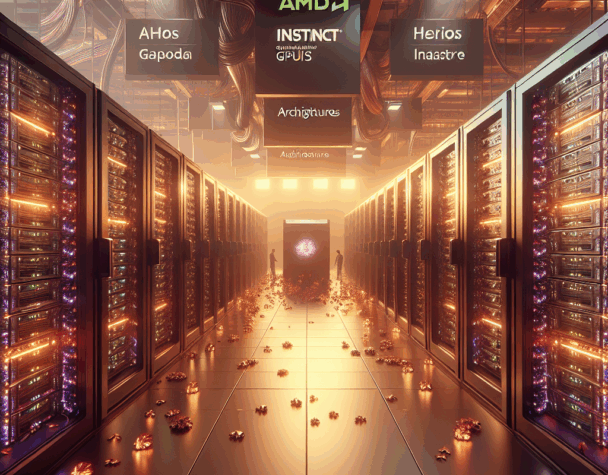
Cloud provider Vultr announced a planned $1 billion investment to build a dedicated AI cluster, reportedly using thousands of AMD Instinct MI355X GPUs. A large-scale deployment of this type does more than boost near-term revenue; it demonstrates customer confidence in AMD’s GPU stack for production AI workloads. For AMD stock, tangible, contracted deployments by hyperscaler-adjacent customers help convert product credibility into recurring infrastructure revenue — a category investors prize for predictability and scale.
HPE endorses Helios: OEM validation for an open alternative
HPE’s decision to integrate AMD’s Helios rack architecture into its product lineup provides OEM-level validation of AMD’s approach to rack-scale AI. Helios emphasizes Ethernet-based interconnects (UALoE) and open standards, enabling configurations with large arrays of MI455X GPUs and EPYC CPUs. HPE’s endorsement shortens the adoption cycle for enterprise customers that prefer vendor-backed, support-ready systems over bespoke integrations — again turning architectural promise into purchasable systems.
Profitability and pricing: a mixed signal
While these wins strengthen AMD’s position in AI infrastructure, recent reporting shows two counterweights investors should watch closely:
- Profit margin gap: Nvidia continues to command exceptionally high gross and operating margins (reported levels north of the mid-60s to 70% in gross margin territory), making it the most profitable play in AI silicon. AMD has signaled ambition to improve margins toward a mid-30% pro forma level — meaningful progress if achieved, but materially below Nvidia’s current profitability.
- Distributor price adjustments: AMD reportedly prepared price increases for certain 9000-series CPUs and may apply increases to some GPUs. Price hikes boost per-unit margin but carry demand risk, especially in price-sensitive segments and against aggressive competitor pricing.
These dynamics create a tightrope: AMD can use rising prices and higher-margin AI deployments to improve earnings, but overly aggressive pricing could slow adoption at a time when scale is crucial for long-term infrastructure share.
Investor implications — clarity, not certainty
The week’s developments narrow the range of outcomes for AMD but do not eliminate uncertainty. Key takeaways for investors:
- Revenue mix shift: Repeatable, large-scale cloud and OEM deals (like Vultr and HPE) point revenue toward higher-value infrastructure contracts rather than one-off consumer cycles.
- Competitive positioning: Helios positions AMD as an open, Ethernet-centric alternative to proprietary interconnect approaches — potentially attractive to enterprises prioritizing flexibility and cost control.
- Margin trajectory watch: Reported price increases could improve margins if demand holds. Compare that potential with Nvidia’s premium profitability to judge whether AMD is closing the gap or merely stabilizing.
- Sentiment signals: Market reaction this week was restrained: AMD saw modest gains amid broader semiconductor strength, suggesting investors recognize progress but remain cautious about execution risks.
Bottom line
This week’s concrete deployments and OEM endorsements move AMD one step closer to translating engineering wins into durable enterprise revenue. Vultr’s large-scale Instinct deployment and HPE’s Helios adoption reduce execution ambiguity — they are the kind of events that can shift investor focus from speculative product promises to measurable demand. However, margin realities and pricing moves require monitoring: scalable profit improvement will be as important to AMD’s stock narrative as growing customer footprints.
Investors should prioritize tracking subsequent procurement announcements, ASP trends on AMD’s server and accelerator lines, and adoption timelines from HPE and other OEMs. Those data points will tell whether this week represents an inflection toward enterprise traction or an early phase of a longer, contested battle for AI infrastructure share.
Quick data snapshot
- Vultr investment: $1 billion AI cluster using AMD Instinct GPUs (large-scale deployment).
- HPE: OEM adoption of AMD Helios rack architecture (availability expected next year).
- Competitive context: Nvidia’s margins remain substantially higher; AMD targeting improved pro forma margins.
- Pricing: reported distributor-level price increases for AMD 9000-series CPUs and potential GPU adjustments.
These items together create a clearer, actionable story for AMD: advancing from product competitiveness to commercial deployments while navigating margin and pricing trade-offs that will shape investor returns.