
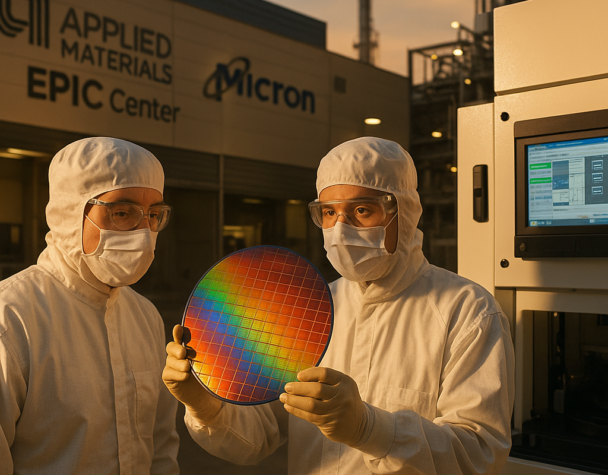
AMAT-Micron EPIC Spurs HBM, Memory Tool Demand Now
Fri, March 20, 2026Introduction
This week brought concrete developments for Applied Materials (NASDAQ: AMAT) that matter to investors and equipment planners alike. A confirmed partnership with Micron announced on March 10 centers on joint R&D at Applied’s EPIC Center and targets next‑generation DRAM, high‑bandwidth memory (HBM) and NAND. Coupled with industry updates highlighting supply‑chain stressors and regional fab investments, these events point to tangible, near‑term implications for AMAT’s product demand and strategic positioning.
What the Micron Collaboration Means for AMAT
Technical focus: HBM, DRAM and NAND
The Micron–Applied Materials collaboration is explicitly aimed at co‑developing process technologies and tooling for HBM, DRAM and NAND. For Applied, that maps directly to its advanced materials, deposition, and etch platforms that are critical in scaling memory nodes and stacking architectures used in HBM. In plain terms, this partnership accelerates customer validation cycles — shortening the path from prototype tools to production orders.
Strategic importance: onshoring and IP integration
By leveraging Applied’s EPIC Center in Silicon Valley alongside Micron’s R&D in Idaho, the agreement emphasizes domestic co‑innovation. That alignment matters given U.S. policy incentives for onshore semiconductor capacity and the desire by large memory producers to localize key development work. For AMAT, deeper technical integration with a major memory producer reduces adoption friction and can translate into larger, earlier tool engagements when Micron scales capacity.
Industry Signals That Could Influence AMAT Orders
Helium and specialty gas tightness
Recent weekly industry updates have flagged supply risks for process gases — helium among them — that chipmakers monitor closely. Disruptions or price spikes in specialty gases can force fabs to adjust production schedules or accelerate investment in alternative processes and tooling to maintain yields. For Applied, customers reacting to gas constraints may either delay or re‑prioritize capex; conversely, they may seek equipment upgrades that mitigate dependence on constrained inputs, creating pockets of demand for specific AMAT systems.
Regional investment trends: Japan, Europe and China
Confirmed movements in regional investment—such as expanded Japanese subsidies for local semiconductor initiatives and Europe’s pilot fab projects—are prompting capacity buildups outside China. While not speculative, these shifts change where and how equipment is deployed. AMAT’s product mix and service footprint will be tested as customers diversify production locations; equipment vendors that can support fast qualification and local service tend to capture a greater share of new fab tooling.
What This Means for Investors and Stakeholders
The Micron collaboration represents a concrete, near‑term revenue catalyst in the form of deeper R&D engagement and an improved path to production orders for memory tooling. At the same time, supply‑chain signals and regional capex shifts introduce variability in timing and geography of purchases. Investors should view the partnership as positive evidence of AMAT’s technological relevance in memory — especially HBM for AI workloads — while monitoring capex timing and reported backlog for confirmation of order conversion.
Conclusion
Recent confirmed events give Applied Materials a stronger position in memory tooling through a formal Micron partnership at the EPIC Center, and sectorwide operational signals (gas supply, regional investments) are likely to influence how and when customers deploy new equipment. These are practical, verifiable developments that enhance AMAT’s strategic footprint in memory technologies while introducing measurable variables in order timing and geographic deployment.