
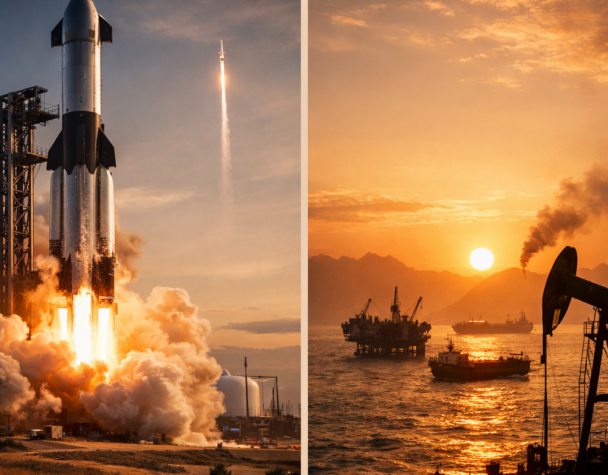
SpaceX $25B Bond Deal Shakes Credit; Oil Falls Now
Sun, June 28, 2026Introduction
Two concrete developments within the past 24 hours are reshaping near-term investment decisions: SpaceX’s record $25 billion corporate bond issuance and a sharp drop in oil prices after shipping resumed through the Strait of Hormuz. Each item carries distinct implications—one for credit investors and infrastructure finance, the other for energy traders, shipping firms, and commodity hedges. This article breaks down the facts, the immediate consequences, and practical steps investors and portfolio managers can consider.
SpaceX’s $25 Billion Bond Offering: What Happened
On June 26, 2026, SpaceX closed a large multi-tranche bond sale totaling roughly $25 billion. The deal included five maturities stretching from 5 to 30 years, with coupon levels ranging from about 5.35% on the shortest tranche up to roughly 6.65% on the longest. Reported demand was enormous—order books were said to approach $85–89 billion—allowing the company to refinance a $20 billion bridge facility and to fund long-term projects such as AI and data-center capacity expansion and general corporate purposes.
Why this matters for credit investors
- Scale and investor appetite: Institutional buyers showed strong willingness to absorb long-dated, sizeable corporate paper tied to a speculative-grade, capital-intensive issuer. That appetite loosens constraints on how large technology and infrastructure financings can be structured.
- Yield and duration dynamics: Coupons in the mid-5% to mid-6% range for 10–30 year tenors offer a benchmark for other high-yield, long-dated financings in sectors such as aerospace, data infrastructure, and renewable energy.
- Private-to-public funding bridge: The transaction illustrates how high-profile private companies can tap public fixed-income channels at scale, changing the playbook for growth-stage capital allocation and refinancing strategies.
Investor actions to consider
- Fixed-income allocators should reexamine credit limits for long-duration, high-yield paper—particularly in sectors where real assets and scale investments dominate the balance sheet.
- Credit analysts ought to stress-test cash-flow scenarios for issuers using proceeds for high-capex projects, with an emphasis on sensitivity to revenue timing and capital intensity.
- Portfolio managers may consider allocating a small strategic sleeve to selective long-dated corporate bonds if yields compensate for credit and duration risk, but only with robust covenants and transparency on use of proceeds.
Oil Prices Drop After Strait of Hormuz Shipments Resume
On June 25–26, 2026, Brent and WTI crude prices fell sharply—Brent down roughly 4.3% near $72/barrel and WTI about 3.7% near $69/barrel—after shipping through the Strait of Hormuz resumed following a recent incident that had paused some tanker flows. The reopening eased acute supply anxiety and triggered a rapid repricing of energy-related assets.
Niche implications for energy and shipping investors
- Short-term volatility: Energy traders and hedgers should expect heightened short-duration price swings tied to chokepoint events. Quick reopenings can erase risk premia fast.
- Shipping and logistics equities: Companies tied to tanker capacity and shipping insurance saw immediate pressure as transit risk diminished; those businesses remain sensitive to episodic geopolitical shocks.
- Hedging strategies: Commodity hedges should be tailored to event risk windows—using shorter-dated options or collars when geopolitical flash points remain unresolved.
Intersection and Broader Takeaways
These two developments highlight a bifurcation in investor priorities this week. Large institutional capital is willing to underwrite long-term credit for high-profile, capital-heavy ventures, while commodity-linked assets continue to react almost instantaneously to geopolitical developments in narrow geographic chokepoints.
Analogy: think of capital flows as a highway with two lanes. The long-term credit lane is accepting heavier, slower vehicles (large bond deals financing infrastructure) because the road has been widened by investor demand. The short-term commodity lane is still subject to sudden roadblocks—accidents or temporary closures—that can reroute traffic in minutes.
Conclusion
SpaceX’s massive bond sale is a signal that institutional credit capacity for long-duration, high-yield financings remains strong, potentially enabling other capital-intensive firms to access similar funding paths. Meanwhile, the rapid fall in oil prices after the Strait of Hormuz reopened shows how quickly event risk can unwind energy-related premiums. Investors should treat these developments distinctly: reassess credit frameworks and duration exposures for corporate debt, and maintain nimble, event-aware hedging for energy and shipping exposures.
Practical next steps include updating stress tests for long-dated credit, reassessing liquidity and covenant protections in new bond allocations, and tightening short-duration hedges for commodity exposures sensitive to geopolitical chokepoints.