
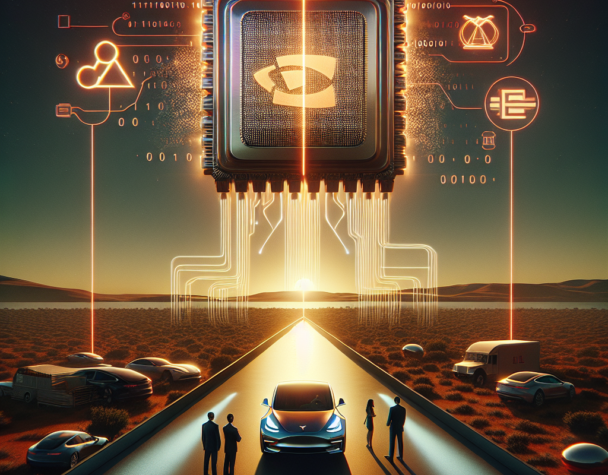
Nvidia’s $20B Groq Deal and Tesla Door Probe
Sat, December 27, 2025Introduction
Two concrete developments in the past 24 hours have immediate, measurable implications for investors: Nvidia’s large-scale asset acquisition and licensing deal with AI startup Groq, and the U.S. National Highway Traffic Safety Administration’s (NHTSA) probe into a mechanical door-release issue affecting roughly 179,000 Tesla Model 3 vehicles. The first is a broad-capital move that accelerates consolidation in AI hardware; the second is a regulatory action with direct operational and reputational consequences for a single EV maker and its ecosystem.
Nvidia’s $20 Billion Deal with Groq: What Happened
Nvidia announced a transaction that involves licensing and the acquisition of assets from Groq valued at about $20 billion in cash. This is a material, transaction-based development rather than conjecture: it represents significant capital deployment by one of the world’s dominant AI chipmakers into specialized AI accelerator technology and related intellectual property.
Why the deal matters
- Scale of capital: A $20 billion outlay signals continued aggressive investment into AI infrastructure even during late-year windows when firms typically slow material M&A activity.
- Consolidation of capability: Acquiring Groq assets and licensing technology suggests Nvidia is not only buying IP but also tightening control over performance differentiation in AI accelerators.
- Cross-sector implications: Data centers, cloud providers, enterprise software vendors, and downstream semiconductors that feed into AI compute stacks will feel the effects as customers and partners adjust procurement, integration, and roadmaps.
Concrete near-term effects for investors
- Re-rating of semiconductor suppliers: Firms supplying wafers, packaging, and advanced node capacity tied to AI chips could see renewed order momentum, especially those with strong Nvidia exposure.
- Capital allocation shifts: Portfolio managers may reweight toward AI-capex-exposed sectors (chipmakers, data-center hardware) as strategic M&A by a market leader reduces competitive uncertainty for customers looking to standardize on a dominant stack.
- Supply-chain scrutiny: Companies upstream (AOI, substrate, cooling systems) become more relevant as AI computing scale expands.
NHTSA Investigation into Tesla Model 3 Door Release
Separately, the NHTSA opened an inquiry into a mechanical door-release accessibility issue on certain 2022 Tesla Model 3 vehicles—impacting approximately 179,000 cars. This is a regulatory safety probe tied to tangible product design and human-safety considerations rather than market rumor.
Why this is material for the EV niche
- Regulatory focus: The probe raises the likelihood of required design revisions, software updates, or recalls if regulators determine the issue impairs occupant egress in emergencies.
- Cost and timing: Even limited recalls or mandated fixes carry direct expense and can divert engineering and manufacturing attention at scale, affecting delivery cadence and margins.
- Investor sentiment in concentrated plays: Tesla-centric funds, EV-component suppliers closely tied to Tesla, and auto-focused active managers will monitor outcomes closely since regulatory actions create measurable operational risk.
Immediate investor considerations
- Watch regulatory filings: Official NHTSA updates, Tesla’s remedial plans, and any voluntary disclosures will be the primary information flow for assessing financial impact.
- Supplier knock-on effects: Tier-1 and Tier-2 suppliers contracted to door mechanisms, latches, or interior trim parts linked to the issue could see order changes or warranty exposure.
- Reputational angle: Repeated safety probes can increase perceived risk for a brand, which can translate to shorter-term volatility in EV-focused ETFs and derivatives positions.
Comparative Analogy: Consolidation vs. Correction
Think of Nvidia’s move as a bank making a big acquisition of fintech infrastructure—consolidating market power and accelerating product roadmaps. The Tesla probe, by contrast, is a targeted compliance correction akin to a bank being fined for procedural lapses in an operational area: both matter, but they act on different axes—strategic scale versus operational integrity.
Practical Takeaways for Investors
For broad-tech and AI investors
- Examine supplier exposure: Identify companies providing critical inputs to AI chips and data-center deployments; these may benefit from increased capital spending.
- Monitor integration risks: Large acquisitions bring execution risk. Track how Nvidia plans to integrate Groq assets and any near-term guidance updates on capex and R&D.
For EV and auto investors
- Focus on evidence-based impact: Follow NHTSA notices, Tesla warranty disclosures, and supplier earnings commentary for quantifiable cost estimates rather than conjecture.
- Diversify within the niche: Given regulatory concentration risk around a single OEM, diversification across EV manufacturers and component suppliers can reduce idiosyncratic exposure.
Conclusion
Both developments are concrete, event-driven inputs for investment decision-making. Nvidia’s $20 billion licensing and asset acquisition from Groq accelerates consolidation and capital deployment in AI hardware, with ripples across semiconductors and data-center suppliers. The NHTSA’s Tesla door-release probe is a focused regulatory event that heightens operational and compliance risk within the EV niche. Investors are best served by parsing official disclosures, following supplier links to each story, and distinguishing strategic, long-term shifts from short-term operational disturbances.