
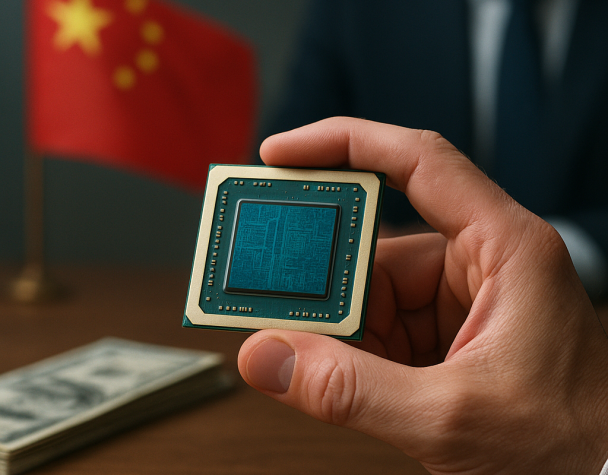
Nvidia Wins Conditional China Clearance for H200 Chips as Family Offices Cut Direct Deals
Wed, November 25, 2026Nvidia has received conditional U.S. approval to sell its H200 artificial-intelligence processors in China, while family offices are pulling back from direct company investments as tariff uncertainty and geopolitical tensions weigh on dealmaking. The developments highlight how government policy and shifting private-capital risk appetite are reshaping investment flows across technology and alternative assets.
Nvidia’s H200 China Access Comes With a Revenue Share
President Donald Trump said the United States would allow Nvidia to sell its more advanced H200 AI chips to approved customers in China, provided the U.S. government receives a 25% share of the sales value. The announcement marks a policy shift from the tighter restrictions that had limited China’s access to Nvidia’s most capable processors.
The H200 is designed for data-center AI workloads, including the training and operation of large language models. Access to the chips could support Chinese technology companies and cloud providers, while giving Nvidia a path to recover some business in one of the world’s largest technology markets.
For investors, the arrangement creates both an opportunity and a new layer of uncertainty. Nvidia could gain additional revenue if licenses are granted and Chinese customers resume purchases, but the conditions show that semiconductor sales remain closely tied to U.S. trade and national-security policy. The 25% government share would also affect the economics of any approved transactions.
The policy does not represent unrestricted access to Nvidia’s products. Sales remain subject to approval, and the commercial impact will depend on which customers receive licenses, how quickly shipments can begin and whether future administrations maintain the arrangement.
Family Offices Reduce Direct Investment Activity
Private investment offices belonging to wealthy families made 55 direct investments in companies during November, according to data cited by CNBC from private-wealth platform Fintrx. The figure was down 5% from October and 37.5% from the same month a year earlier.
The decline suggests that family offices are becoming more selective in committing capital directly to private companies. Tariff uncertainty, geopolitical conflict and concerns about valuations are contributing to a more cautious deal environment, even as interest remains strong in artificial intelligence and related infrastructure.
AI continues to attract high-net-worth capital. Recent family-office investments have included biotechnology companies using generative AI for gene editing and health-monitoring businesses focused on early disease detection. The pattern indicates that investors are not abandoning private markets, but are concentrating capital in themes perceived to have strong long-term growth potential.
Family offices may also be retaining greater flexibility by favoring public-market exposure, funds and secondary transactions over new direct investments. That approach can reduce the time and underwriting burden associated with backing individual private companies while preserving access to technology, health care and infrastructure themes.
Policy Risk and Selective Capital Allocation
Together, the two developments show how investment decisions are being shaped by both policy intervention and risk discipline. Nvidia’s China opportunity is dependent on government licensing and revenue-sharing terms, while family offices are narrowing the range of private-company bets despite continued enthusiasm for AI.
Investors will be watching whether Nvidia receives broad approval for H200 shipments and whether the company can convert the policy change into meaningful sales. In private markets, the key indicators will be whether direct-investment activity remains subdued and whether capital continues to move toward AI infrastructure, biotechnology and other specialized sectors.