
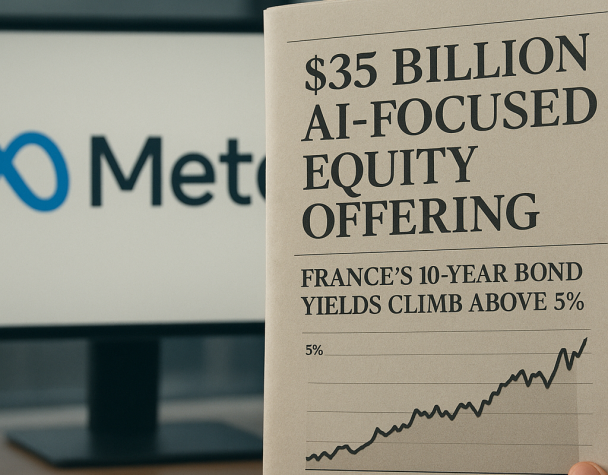
Meta Launches $35 Billion AI-Focused Equity Offering as France’s 10‑Year Bond Yields Climb Above 5%
Tue, October 27, 2026Meta Platforms has launched a substantial $35 billion equity offering, aiming to fund its accelerated investments in artificial intelligence infrastructure, according to recent market reports and company filings. This move marks one of the largest technology sector equity capital raises in 2026 and underscores Meta’s commitment to scaling AI operations amid a competitive tech investment landscape.
Meta’s $35 Billion AI-Driven Capital Raise
Meta’s $35 billion share offering was announced this week, with company disclosures confirming that the proceeds will support deepening the firm’s AI infrastructure, including data center expansion and AI research & development. The equity offering drew attention from capital markets analysts, reflecting confidence in AI’s strategic centrality to Meta’s growth trajectory. Investor response was volatile, but market commentary suggests the capital raise reinforces Meta’s long-term AI ambitions.
France’s 10-Year Bond Yields Surge Past 5%
Concurrently, French government 10‑year bond yields have climbed past 5% for the first time since July 2002, highlighting a surge in borrowing costs for the eurozone’s second-largest economy. The yield spike, driven by investor concerns over fiscal risks, including the potential implications of upcoming elections and budgetary uncertainty, adds pressure to sovereign borrowing and may ripple across European fixed-income markets.
Investor Implications
Meta’s aggressive equity raise reflects a broader trend in which major tech firms are mobilizing capital to secure their competitive position in AI, even at the cost of significant shareholder dilution. The size and timing of the offering suggest Meta anticipates sustained demand for AI-driven services and infrastructure.
Meanwhile, France’s rising bond yields signal increased market scrutiny on sovereign risk and fiscal discipline within Europe. For fixed-income and sovereign debt investors, the move raises questions about the trajectory of interest rates and the cost of capital for European governments. It may also prompt recalibrations in portfolio allocations away from French or other eurozone bonds toward safer or higher-yield alternatives.
Together, these developments illustrate the divergent pressures facing capital markets today: technological ambition prompting unprecedented equity mobilization on one side, and macroeconomic uncertainty elevating sovereign financing costs on the other.
Investors may watch Meta’s execution of its AI expansion closely for signs of return on the newly raised capital, while policymakers in France will face growing pressure to address perceived fiscal risks to stabilize borrowing costs.
As both stories evolve, the interplay between innovation-led capital deployment and macroeconomic constraints underscores the complex investment environment of late 2026.