
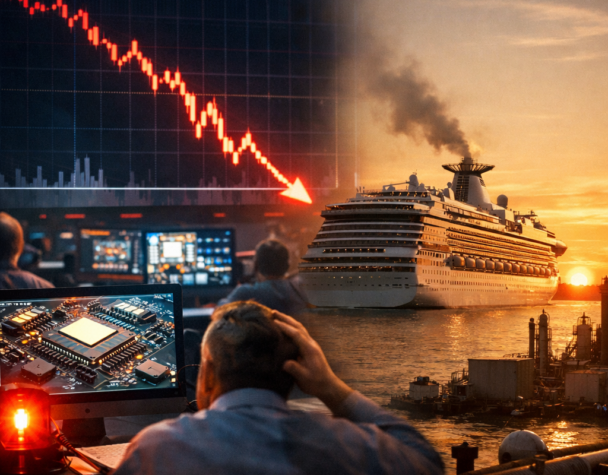
KOSPI Plunge Slams AI Chip Stocks; Carnival Warns
Wed, June 24, 2026Introduction
Two distinct developments in the past 24 hours have immediate implications for investors: a sudden KOSPI sell‑off that sent ripples through AI‑infrastructure chip stocks, and a profit warning from Carnival that exposed persistent fuel‑cost pressure in the cruise and travel sector. Together, they show how concentrated sentiment shifts and commodity cost dynamics can quickly reshape risk and return expectations across different corners of the investment universe.
KOSPI Circuit Breaker and the AI‑Chip Sell‑Off
What happened
South Korea’s KOSPI index plunged by more than 5%, briefly triggering market circuit breakers. The drop was driven largely by profit‑taking in names tied to artificial‑intelligence infrastructure and semiconductors. Major suppliers and equipment makers—names such as ASML, Qualcomm, KLA, Applied Materials, Micron, Marvell and Western Digital—saw pronounced weakness as investors pared positions after a run of strong gains.
Why it matters beyond Korea
South Korea is a central node in the semiconductor and AI hardware supply chain. A sudden, steep move there is not just a regional correction; it can presage reassessments of demand, capital spending and supply‑chain risk for AI infrastructure globally. The KOSPI event demonstrates how concentrated buying in one theme (AI chips and equipment) can create fragility—when momentum reverses, volatility propagates quickly through correlated stocks and ETFs.
Investor implications
- Reassess concentration risk: Portfolios overweight in AI‑infrastructure names may see amplified drawdowns during sentiment reversals.
- Watch leading indicators: South Korean market moves can act as an early signal for broader semiconductor sentiment shifts, given the country’s outsized role in manufacturing and equipment.
- Focus on fundamentals: Rapid price moves often separate market psychology from underlying revenue and capex trends; prioritize companies with resilient margins and diversified end markets.
Cruise Sector Shock: Carnival’s Profit Guidance Miss
What was announced
Carnival issued a current‑quarter profit forecast below analyst expectations and attributed the shortfall primarily to elevated fuel costs. Although headline earnings beat recent estimates, the forward guidance disappointed investors and led to an immediate share price drop of roughly 6%.
Why this is important within the travel niche
The cruise business is capital‑intensive and highly sensitive to commodity input costs. When fuel costs rise, operators face eroding margins unless they can pass costs to consumers through higher fares. Carnival’s guidance miss underscores two structural vulnerabilities: limited short‑term pricing power in certain itineraries and lingering cost inflation pressures that can compress profitability even amid healthy passenger demand.
Takeaways for sector investors
- Monitor fuel hedging disclosures and forward fuel curves—these materially affect near‑term margins.
- Evaluate fare mix and ancillary revenue trends—companies with stronger pricing power or diversified revenue streams will weather input cost shocks better.
- Expect heightened guidance sensitivity—travel stocks can react sharply to even modest downward revisions in forward expectations.
How These Events Fit Together
While the KOSPI sell‑off and Carnival’s warning affect very different segments, they share a common lesson for investors: thematic momentum can reverse quickly, and cost dynamics can undermine profitability even when demand seems solid. The AI trade demonstrates how sentiment can inflate valuations and create fragility. The Carnival case shows that tangible, commodity‑driven headwinds can swing guidance and stock performance despite positive operational metrics.
Practical portfolio moves
- Implement position sizing and stop limits for thematic or high‑beta holdings to limit downside from abrupt reversals.
- Diversify along the supply chain: in tech, mix exposure to both equipment suppliers and more defensive semiconductor applications; in travel, balance pure leisure operators with businesses that have diversified revenue streams.
- Use options or hedges selectively where concentrated risk is unavoidable—protective puts or collar strategies can manage downside without exiting positions entirely.
Conclusion
The last 24 hours provide a compact reminder that investment risk arises from both sentiment swings and real economic pressures. The KOSPI plunge highlights how quickly concentrated enthusiasm for AI infrastructure can reverse, producing outsized volatility. Carnival’s guidance miss reinforces that input‑cost shocks—fuel in this case—remain a live risk for cyclical, capital‑intensive industries. Investors who combine discipline on position sizing, attention to forward guidance, and selective hedging will be better positioned to navigate these episodic but consequential shocks.