
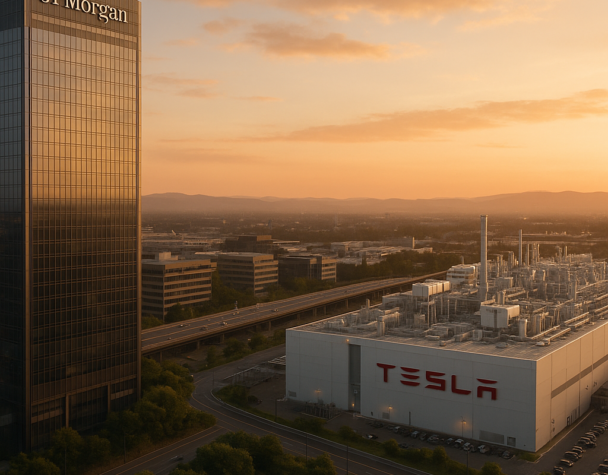
JPMorgan $8B Junk Bonds Fuel EA LBO; Tesla Terafab
Tue, March 24, 2026Introduction
Two consequential financing and industrial moves surfaced within the last 24 hours: JPMorgan led an $8 billion high-yield (junk) bond sale to help fund Electronic Arts’ leveraged buyout, and Tesla, SpaceX and xAI announced plans for a large-scale chip manufacturing campus named Terafab in Austin, Texas. Together they illuminate how credit markets and hardware investment cycles are interacting—one reshaping short-term capital flows and risk management; the other pointing toward longer-term structural shifts in semiconductor supply and vertical integration.
JPMorgan’s $8B High-Yield Deal and the EA LBO
What happened
JPMorgan arranged an $8 billion high-yield bond issuance as part of an approximately $15 billion financing package for the leveraged buyout of Electronic Arts. The deal reportedly drew about $25 billion of investor interest, indicating robust appetite for yield-bearing debt despite geopolitical and macroeconomic uncertainty. The bank also reallocated a portion of the financing into roughly $5 billion of dollar-denominated loans and introduced a new credit default swap (CDS) basket focused on major tech names as a hedging product.
Implications for credit and investor positioning
- Liquidity and risk appetite: Strong demand for the bond issuance suggests investors remain willing to take on credit risk for higher yields, supporting underwriting capacity for large buyouts.
- Shift to loan exposure: The move to increase loan allocations can reflect lenders’ preference for secured or syndicated loan structures where covenants and priority matter more than in unsecured high-yield bonds.
- CDS and sector hedging: Launching a CDS basket tied to big-tech names signals rising institutional concern about concentrated sector risk—particularly around AI-related exposures—and a desire for tools to hedge credit deterioration across correlated issuers.
For fixed-income and credit-focused investors, the transaction is a clear reminder that primary issuance can accelerate when yield is available and that sophisticated hedging products will follow where concentration risk is perceived.
Terafab: Tesla, SpaceX and xAI’s Chip Campus
What’s being built
The Terafab initiative in Austin aims to produce semiconductors for electric vehicles, humanoid robots, and AI data centers optimized for space-based and terrestrial applications. Initial production is targeted for late 2027 with a larger ramp in 2028. Barclays cautioned that capital expenditures for such a venture could substantially exceed earlier estimates—potentially surpassing $50 billion over time—reflecting the scale and complexity of advanced chipmaking.
Why Terafab matters to niche investors
- Vertical integration: Terafab underscores Tesla’s broader strategy to internalize critical hardware—reducing exposure to external supply shocks and geopolitical restrictions.
- Supply-chain resilience: Onshoring or near-shoring advanced packaging and wafer production helps insulate key programs (EVs, robotics, space systems) from cross-border bottlenecks.
- Capital intensity and timelines: Semiconductor fabs are multi-year, capital-heavy projects. Investors tracking hardware, industrials, and specialized suppliers should expect extended lead times before material revenue impacts.
For infrastructure and tech supply-chain investors, Terafab is less about short-term returns and more about positioning for an emerging integrated stack linking automotive, AI compute, and aerospace needs.
How These Moves Interact for Investors
At first glance, the JPMorgan-led financing and the Terafab announcement occupy different horizons: one concerns near-term credit distribution and hedging; the other concerns long-term capital deployment in semiconductor capacity. However, they intersect in meaningful ways:
- Large corporate financings—and the appetite to underwrite them—feed liquidity into credit markets that can backstop capital-intensive industrial projects when debt markets remain receptive.
- Heightened demand for hedging products (e.g., CDS baskets) reflects a broader sensitivity to concentrated tech exposure, which is relevant for firms pursuing big hardware bets tied to AI and robotics.
- Investors should weigh credit-market dynamics (spreads, issuance appetite) alongside structural shifts in supply chains; where cheap or available financing exists, ambitious industrial projects become more feasible.
Conclusion
JPMorgan’s sizeable high-yield placement for the EA buyout signals continuing investor willingness to fund leveraged transactions and an evolution in credit-risk tools for tech exposure. Meanwhile, Terafab highlights how major corporations are committing to capital-intensive semiconductor strategies to secure supply and accelerate product roadmaps. Together these developments suggest a dual investment theme: active credit deployment in the near term and targeted, large-scale industrial investment in hardware capacity over the medium-to-long term—each presenting distinct opportunities and risks for disciplined investors.