
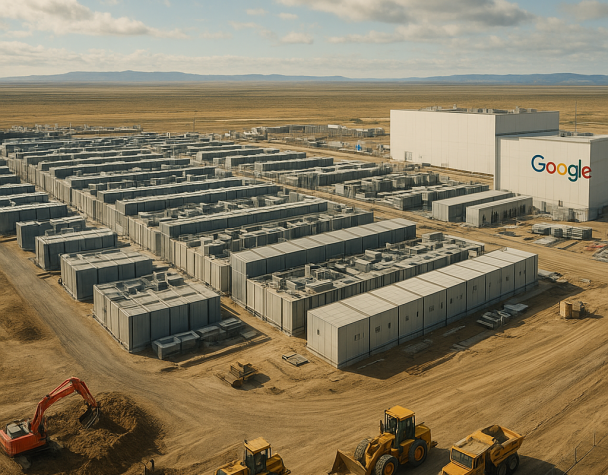
Google Advances $17 Billion Wyoming Data-Center Buildout as SoftBank’s AI Portfolio Swings to a Loss
Sun, November 15, 2026Google is moving ahead with plans for a $17 billion data-center project in Wyoming, underscoring the scale of capital flowing into artificial-intelligence infrastructure even as investors reassess the risks surrounding the sector.
The project, reported by TechRadar Pro on November 9, involves Tallgrass Energy, Black Hills Energy, American Electric Power and Related Digital. The development is planned for Laramie County and is expected to require substantial investment in power and supporting infrastructure.
Google’s continued commitment comes as opposition to large data-center projects grows in parts of the United States, where communities and policymakers are weighing electricity demand, land use and the fiscal benefits of AI-related development. For investors, the project highlights the increasingly important role of power generation, transmission and industrial infrastructure in the technology investment cycle.
AI Infrastructure Faces a More Demanding Investment Test
The Wyoming development also illustrates how AI spending is extending beyond chips and software. Data centers require long-term commitments to electricity, cooling systems, construction and network capacity, creating potential opportunities for utilities, energy companies, construction firms and infrastructure investors.
At the same time, the economics of those projects remain exposed to changing demand expectations and political scrutiny. The growing cost of financing and operating large facilities could make power availability and customer commitments increasingly important factors in assessing AI infrastructure investments.
SoftBank Results Highlight Portfolio Risk
SoftBank Group reported a quarterly loss on November 10 as the value and performance of its AI-focused investments weighed on results, according to the Associated Press. Quarterly sales rose 16% to 2.2 trillion yen from 1.9 trillion yen, but the company’s broader investment portfolio remains sensitive to volatile technology valuations.
SoftBank operates investment vehicles including the Vision Fund and has exposure to companies such as OpenAI and Arm Holdings. The group’s results demonstrate how quickly the AI investment boom can affect diversified technology investors, particularly when private-company valuations and publicly traded technology shares move sharply.
SoftBank shares nevertheless closed nearly 14% higher in Tokyo on November 10 before the earnings results were released, according to the AP. The contrast between market sentiment and reported quarterly performance reflects the difficulty investors face in valuing companies whose results depend heavily on large, long-term technology bets.
Together, the developments point to a two-sided AI investment landscape. Companies and infrastructure providers continue to commit billions of dollars to expand computing capacity, while investment firms and holding companies are confronting greater volatility in the assets expected to benefit from that expansion. Investors may increasingly focus on contracted demand, access to power and evidence of cash generation rather than AI exposure alone.