
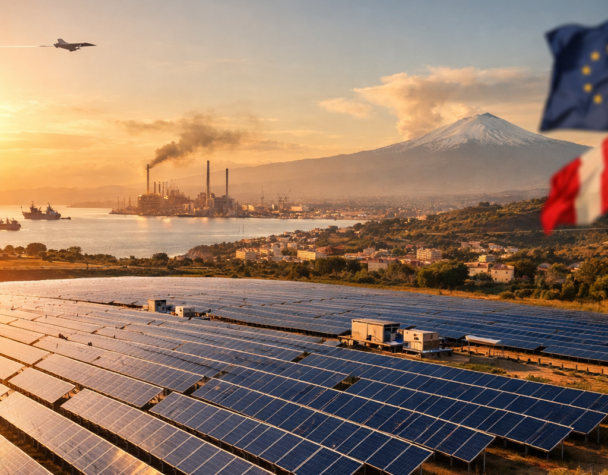
Geopolitics Fuels Capex Shift; Sicily Solar €153M!
Fri, April 10, 2026Introduction
Two concrete developments over the past 24 hours illustrate a clear theme for investors: geopolitical stress is reshaping capital allocation, and institutional financing is following through in targeted green infrastructure. On April 9, 2026, a leading institutional analysis highlighted how geopolitical risk and supply‑chain fragility are forcing corporations and investors to prioritize resilience over pure efficiency, triggering what many are calling a capex supercycle. Complementing that broad shift, on April 8 the European Investment Bank (EIB) and Société Générale signed a €153 million financing package for a 137 MW photovoltaic plant in Sicily — a specific, bankable example of where new capital is flowing.
Geopolitical risk and the emerging capex supercycle
From just‑in‑time efficiency to resilience spending
Recent geopolitical events — including repeated supply‑chain disruptions at strategic chokepoints and a rise in trade and industrial policy intervention — have exposed the limits of a single‑minded focus on cost minimization. Corporations are responding by diversifying suppliers, onshoring or nearshoring critical production, and investing in redundant capacity. That shift translates into sustained increases in capital expenditure across sectors such as energy, industrials, transport infrastructure and advanced manufacturing.
Which sectors are most directly affected
- Energy & utilities: investment in domestic energy production, storage and grid upgrades to reduce import vulnerability.
- Industrial & manufacturing: new plants, automation and regional hubs to shorten supply chains.
- Commodities & materials: higher upstream investment for strategic minerals and inputs.
- Defense & infrastructure: spending on ports, rail, and secure logistics to mitigate chokepoint risks.
- Financial services: banks and insurers adjusting underwriting and capital models for longer‑term sovereign and supply‑chain risk.
These shifts are not ephemeral reactionary moves; they represent structural rebalancing of capital allocation that can persist for years and reshape return drivers across public and private asset classes.
The Sicily solar deal: a concrete sign of institutional momentum
What the €153M financing tells investors
The financing agreement between the EIB and Société Générale for a 137 MW photovoltaic project in Sicily is meaningful for several reasons: it is sizeable and bankable, it involves a multilateral institution and a major commercial bank, and it targets utility‑scale renewables — an asset type that governments and pension funds favor for predictable long‑term cash flows.
For renewable investors, the deal demonstrates that despite macro geopolitical tension, capital continues to flow into decarbonization infrastructure, especially when projects align with policy priorities and offer clear revenue mechanisms (power purchase agreements, feed‑in tariffs, merchant offtake with stable counterparties).
Regional and sectoral implications
- Europe: continued EU institutional support lowers perceived project risk for private investors and can catalyze follow‑on financing.
- Solar pipeline: bankable, shovel‑ready projects in high‑insolation regions will attract institutional capital ahead of riskier greenfield ventures.
- Local impact: construction and operations boost regional employment and supply‑chain localization for components and services.
Practical portfolio implications
Investors should translate these developments into concrete portfolio actions while preserving diversification and liquidity needs.
Equities and corporate credit
- Favor companies with visible capex programs to enhance resilience — industrials, select energy producers, utilities upgrading grids.
- Assess balance sheets for companies accelerating capex; pick names with funding capacity and long‑term contracts that de‑risk investments.
Fixed income and alternative investments
- Look to project finance debt, green bonds and infrastructure debt for predictable, contracted cashflows backed by assets such as solar plants and grid upgrades.
- Consider private investments in renewable pipelines where institutional co‑investment de‑risks execution and accelerates scale.
Commodities, hedging and risk management
- Strategic exposure to base and battery metals may hedge against higher industrial capex and domestic sourcing.
- Use currency and geopolitical event hedges selectively; maintain stress tests for supply‑chain disruptions.
Conclusion
Concrete policy and financing actions over the last 24 hours underscore a broader pivot: the investment narrative is moving from lean globalization toward durable, resilience‑driven capital deployment. The Morgan Stanley‑highlighted capex reorientation points to multi‑sector opportunities, while the EIB and Société Générale’s €153 million commitment to a Sicilian photovoltaic project shows where institutional dollars are already being committed. For investors, the practical takeaway is to favor assets and strategies that benefit from capex spending and infrastructure financing while continuing to manage geopolitical and execution risks through diversification and disciplined underwriting.