
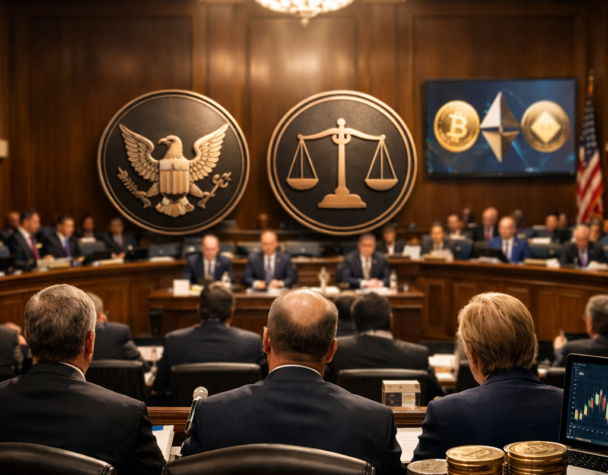
CLARITY Act Advances; SEC/CFTC Define Tokens
Fri, May 15, 2026CLARITY Act Advances; SEC/CFTC Define Tokens
Introduction
In the past 24 hours Washington delivered two consequential moves for digital assets. The Senate Banking Committee advanced the CLARITY Act by a 15–9 vote, and the SEC and CFTC issued a coordinated interpretive release that lays out a multi-category taxonomy for tokens and activity. Together these actions swap a measure of regulatory fog for definitional certainty—an outcome that matters for institutional investors, custodians, token issuers and DeFi builders.
What the legislation and guidance say
CLARITY Act: committee approval and core outcomes
The CLARITY Act cleared the Senate Banking Committee on May 14, 2026, moving the bill closer to a floor vote. Key features: it aims to classify major coins such as Bitcoin and Ethereum as digital commodities under CFTC oversight, and it seeks to codify a judge’s prior ruling that resolved XRP’s legal status. The committee vote was 15–9, signaling meaningful bipartisan support, though full Senate passage requires broader backing (a 60-vote threshold in many procedural contexts).
Market reaction was immediate: in intraday trading, Bitcoin rose toward the low $80,000s and Ethereum climbed above $2,200—moves that reflect relief over reduced legal ambiguity. But the bill’s rulemaking and implementation are expected to unfold over 12–24 months, making this a structural development rather than a short-term fix.
SEC and CFTC joint interpretive release: categories and activities
Complementing the bill, the SEC and CFTC published coordinated guidance that establishes a five-category taxonomy for digital assets: digital commodities, digital collectibles, digital tools, stablecoins and digital securities. Importantly, the agencies clarified that a range of common activities—airdrops, staking, protocol mining and token wrapping—do not automatically trigger securities registration when performed under defined conditions.
The release also introduced the idea of dynamic labeling: token classifications can change over time depending on governance outcomes and issuer behavior. This gives token teams a clear compliance ladder: design the economics and governance to meet commodity-style standards, and avoid characteristics that would continue to tether a token to securities law.
Implications for investors, DeFi and issuers
Institutional investors and custodians
Regulatory clarity is the single largest barrier keeping some institutional capital on the sidelines. Think of it like a locked gate on a highway: until the signage is unambiguous, large players—pension funds, insurers, endowments—won’t take the exit. With the CLARITY Act’s committee approval and the SEC/CFTC taxonomy, custody providers and exchanges can better model compliance, insurers can price risk more precisely, and spot and futures products stand to attract more inflows.
That said, full institutional adoption depends on final legislation and implementing rules. Expect a staged shift: compliance-heavy entrants (custodial ETFs, regulated futures) first, followed later by broader product innovation.
DeFi protocols, token issuers and fundraising
The joint guidance is a pragmatic play for DeFi: it gives engineers and legal teams guardrails for token design—how to structure airdrops, staking incentives, and governance so tokens remain outside securities treatment. Projects that align with the taxonomy will reduce their enforcement risk; those that don’t may need to reconsider token mechanics or pursue exemptions.
For startups and token issuers, the guidance enables clearer fundraising roadmaps. Venture and treasury managers can model dilution and token economics against a predictable regulatory baseline, potentially unlocking capital that was previously withheld because of legal uncertainty.
Short-term market effects vs. long-term structural change
In the short term, these announcements can spur price appreciation and trading volume as uncertainty bids fall—already visible in recent intraday moves. Over the long term, the impact is institutional: more participants, standardized custody and reporting, and a stronger bridge between traditional finance and crypto-native infrastructure. The timeline will be phased—legislative votes, followed by rulemaking, then market adaptation.
Conclusion
The twin developments—the CLARITY Act advancing through committee and the SEC/CFTC’s taxonomy—are meaningful because they convert ambiguity into actionable rules. For investors, the headline is clearer risk calculus; for builders, it’s an invitation to design with regulatory reality in mind. While the process ahead includes votes and rulemaking that will take months to years, the direction is now leaning toward defined, interoperable frameworks for digital assets.
Keywords: CLARITY Act, crypto regulation, CFTC, SEC, digital assets, token classification, DeFi, institutional investors.