
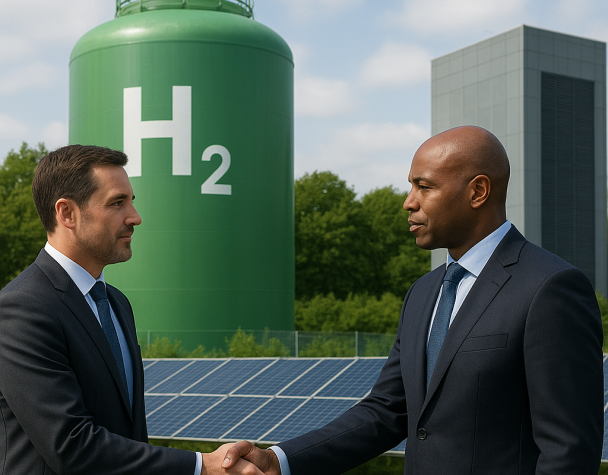
Brookfield Commits $600 Million to ACME’s Green Fuels Push While AI Data Center Finance Faces Cooling After Oracle’s Force Majeure
Sat, September 26, 2026Brookfield has unveiled a significant new investment stepping into the low‑carbon fuel space. Its Global Transition Fund will invest up to $600 million in India’s ACME Cleantech Ventures to support the development of green ammonia and methanol projects in both India and Oman, marking Brookfield’s strategic entry into this emerging sector. ACME already counts major international companies among its customers, including Norway’s Yara International, Japan’s IHI Corporation and Mitsubishi Gas Chemical, as well as Indian buyers. Brookfield expands its existing footprint in India’s renewables market, where it already manages around 50 GW of operating and pipeline wind and solar assets.
This move underlines growing investor interest in cleaner energy alternatives as industries worldwide seek to reduce carbon footprints and align with decarbonisation goals. The scale of Brookfield’s investment and ACME’s customer base suggest meaningful momentum in financing renewable fuels beyond conventional solar and wind sectors.
Oracle’s Force Majeure Notice Sheds Light on Rising Caution in AI Infrastructure Financing
Meanwhile, a sharply different tone is emerging within AI infrastructure financing. Oracle has issued a force majeure notice concerning the Jupiter data‑centre campus being developed by Blue Owl’s STACK Infrastructure for OpenAI. While Oracle affirmed that the notice does not change the commitment to the project, it has triggered a wave of concern among lenders and investors across the high‑growth AI infrastructure market.
The cloud of uncertainty comes amid already mounting challenges in the sector. In Q2, community opposition disrupted approximately $68 billion worth of data‑centre projects, a slowdown following disruptions affecting $130 billion worth of projects in Q1. The Oracle development has become a focal point, as legal safeguards against project delays become more common—and more troubling—for financiers and stakeholders in AI build‑outs.
Why Both Developments Matter to Investors
Brookfield’s commitment represents a rare large‑scale investment in green fuels infrastructure and offers a high‑profile validation of low‑carbon energy as an investable asset class. For investors seeking exposure to decarbonisation trends, the size, structure and strategic partners in this funding make it a benchmark transaction worth watching.
At the same time, Oracle’s force majeure notice highlights growing fragility in sectors driven by rapid infrastructure expansion, especially when facing regulatory, community or logistical friction. It serves as a cautionary signal for lenders and developers: even blockbuster AI projects may encounter structural and execution risks that warrant tighter underwriting, stronger contractual safeguards and rigorous community engagement.
Outlook
Moving forward, investors will likely regard Brookfield’s green fuels play as a leading indicator of capital rotating into low‑carbon value chains, spanning beyond energy generation into feedstocks like ammonia and methanol intended for industrial decarbonisation and export markets. Meanwhile, AI infrastructure funders may refine risk frameworks, while policymakers, developers and financiers assess mitigation strategies for emerging non‑technical project risks.
These twin developments—one expanding horizons in sustainable energy, the other spotlighting unease in AI infrastructure finance—underscore how capital flows are responding asymmetrically across sectors. With billions at stake, the nuance between enthusiasm and caution increasingly defines investment decisions in both renewable and tech‑infrastructure arenas.